
Executive
Waste of the Day: Throwback Thursday: Foreign Aid to Creditors
The United States, as far back as FY 2010, spent millions in foreign aid to America’s creditors, without negotiation of debt relief.


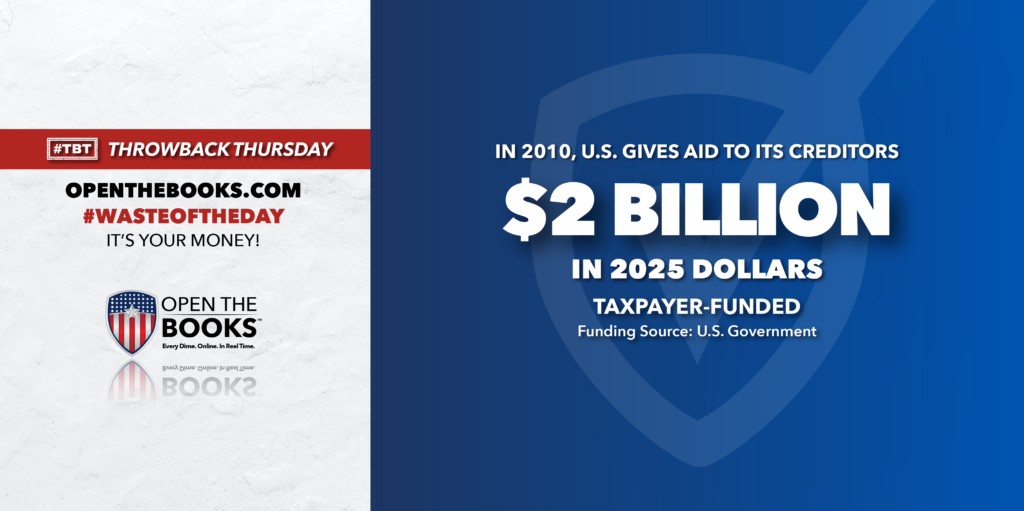
Topline: The national debt is approaching $37 trillion, yet for years the U.S. has been handing out foreign aid to countries it owes money to. In fiscal year 2010, America spent $1.4 billion — or $2 billion in today’s money — on aid to 16 countries that held at least $10 billion of Treasury securities, according to the Congressional Research Service.
How does foreign aid to creditors work – or work out?
The trend continued when the U.S. sent $17.8 million to China in 2011, which is listed in the “Wastebook” reporting published by the late U.S. Senator Dr. Tom Coburn. For years, these reports shined a white-hot spotlight on federal frauds and taxpayer abuses.
Coburn, the legendary U.S. Senator from Oklahoma, earned the nickname “Dr. No” by stopping thousands of pork-barrel projects using the Senate rules. Projects that he couldn’t stop, Coburn included in his oversight reports.
Coburn’s Wastebook 2011 included 100 examples of outrageous spending worth nearly $7 billion, including the foreign aid to China.
Key facts: The national debt was $15 trillion by the end of fiscal year 2010, but lawmakers were obviously in no rush to reduce it. Creditors that received foreign aid in 2010 included Brazil ($25 million), Russia ($71.5 million), India ($126.6 million), Mexico ($316.7 million) and Egypt ($255.7 million).
The $17.8 million sent to China in 2011 included money for social services and environmental health, even though the U.S. already owed China more than $1 trillion.
At the time, FOX News predicted that the U.S. was about to default on its debt to other countries, and reported that “Both sides agree that spending cuts are needed.” Fourteen years later, large-scale spending cuts have yet to materialize, and the federal budget has run a deficit for 25 consecutive years.
Payments continue
Background: The payments to creditors did not end in 2011. The U.S. sent $1.3 billion to China and Russia from 2017 to 2023 for experiments on mice and cats, podcasts on being queer and more, OpenTheBooks previously reported.
Search all federal, state and local salaries and vendor spending with the world’s largest government spending database at OpenTheBooks.com.
Critical quote: Coburn, who requested the report from the Congressional Research Service, said in a 2011 statement,
Borrowing money from countries who receive our aid is dangerous for both the donor and recipient. If countries can afford to buy our debt, perhaps they can afford to fund assistance programs on their own.
At the same time, when we borrow from countries we are supposedly helping to develop, we put off hard budget choices here at home. … The status quo creates co-dependency and financial risk at home and abroad.
Summary: A $36.2 trillion national debt already feels insurmountable without sending additional cash handouts to the countries we owe money to.
The #WasteOfTheDay is brought to you by the forensic auditors at OpenTheBooks.com
This article was originally published by RealClearInvestigations and made available via RealClearWire.

Jeremy Portnoy, former reporting intern at Open the Books, is now a full-fledged investigative journalist at that organization. With the death of founder Adam Andrzejewki, he has taken over the Waste of the Day column.






-

 Civilization5 days ago
Stealth, Sensors, and Staying Power: What the F-35 Just Proved—and What Comes Next
-
 Executive5 days ago
Citizen Sleuths Spotlight Red Flags Galore in Government Spending
-

 Civilization4 days ago
Dems Scramble After California Governor’s Debate Implodes
-
 Executive4 days ago
America’s $130 Trillion Blind Spot
-

 Civilization3 days ago
Iran Could Reshape the Middle East and the Global Balance of Power
-

 Civilization2 days ago
The conversation women are having
-
 Executive2 days ago
Waste of the Day: NYC Thermostat Repairers Made $325K, Thanks to OT
-

 Executive3 days ago
The Assisted Suicide of Lofty State and Local Taxes