
Executive
Waste of the Day: “Low-Value” Medicare Treatments
Medicare is providing “low-value treatments,” also known as bad or at least wasteful medicine, to 37 percent of its patients.



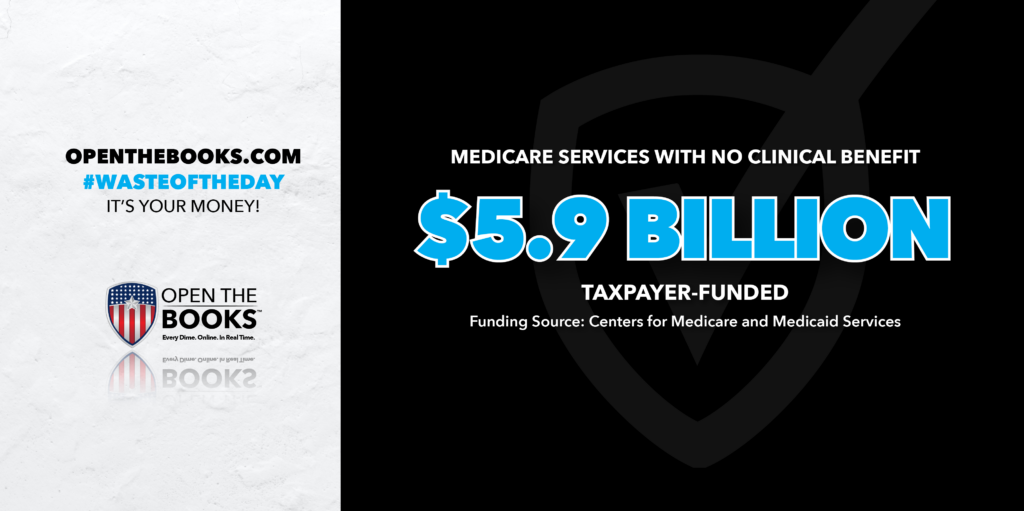
Topline: An estimated 37% of Medicare patients received a “low-value” health care service in 2023, costing the federal government $5.9 billion.
Medicare payment watchdog has the receipts
Key facts: The numbers come from the Medicare Payment Advisory Commission’s (MedPAC) annual “Health Care Spending and the Medicare Program” data book, released on July 1.
MedPAC defines low-value care as a treatment that “has little or no clinical benefit or care in which the risk of harm outweighs its potential benefit.” Using a “narrow” definition of the word, low-value care cost the government $2 billion in 2023. Using a “broad” definition, it cost $5.9 billion, according to the data book.
For example, almost 7% of Medicare patients received a spinal injection for low back pain in 2023, even though medical experts disagree over whether it is an effective treatment. It cost the government $1.3 billion.
Medicare spent $431 million on colon cancer screening for older adults, even though the National Institutes of Health says that “screening is discouraged for people over 85” because it can cause complications like an internal perforation.
Medicare also spent $1.2 billion on stenting to treat stable coronary disease. According to the American Academy of Family Physicians, “most published trials fail to show a benefit from coronary stenting” in patients with stable coronary disease.
While there were 31 kinds of low-value treatments listed by MedPAC, the Commission acknowledges there are more kinds, which could bring the actual number spent on low-value care “much higher” than $5.9 billion, the data book says.
The government has been paying for bad medicine
Medicare spent $956 billion in 2023, which was 23% of the $4.1 trillion spent on personal health care in the U.S., according to the data book. The Treasury projects that Medicare will have a $52.8 trillion shortfall within the next 75 years. (Along with a $25.4 trillion Social Security shortfall)
Search all federal, state and local salaries and vendor spending with the world’s largest government spending database at OpenTheBooks.com.
Summary: With so many Americans struggling to afford health care, it’s essential that government funds are spent on treatments that are beneficial.
The #WasteOfTheDay is brought to you by the forensic auditors at OpenTheBooks.com.
This article was originally published by RealClearInvestigations and made available via RealClearWire.

Jeremy Portnoy, former reporting intern at Open the Books, is now a full-fledged investigative journalist at that organization. With the death of founder Adam Andrzejewki, he has taken over the Waste of the Day column.






-

 Civilization3 days ago
Stealth, Sensors, and Staying Power: What the F-35 Just Proved—and What Comes Next
-

 Executive3 days ago
Citizen Sleuths Spotlight Red Flags Galore in Government Spending
-

 Guest Columns4 days ago
Oklahoma’s Digital Future Will Be Built on Affordable, Reliable, Clean Energy Security
-

 Executive5 days ago
Waste of the Day: Throwback Thursday – Helping Beverly Hills’ Low-Income Community
-

 Civilization2 days ago
Dems Scramble After California Governor’s Debate Implodes
-

 Civilization3 days ago
Waste of the Day: Cybersecurity Programmers Have Foreign Ties
-

 Executive4 days ago
A Consent Decree for Freedom of Speech
-

 Executive2 days ago
America’s $130 Trillion Blind Spot