
Executive
Waste of the Day: Throwback Thursday – Quail on Cocaine
The National Institutes of Health actually spent money getting quail high on cocaine, to find out how cocaine affects their sex drive.



Topline: Everyone knows you can kill two birds with one stone, but the National Institutes of Health was the first to try getting the birds stoned.
Quail on cocaine? Seriously?
In 2011, the NIH spent $357,000 to fund a University of Kentucky study on how cocaine affects the sex drive of Japanese quail. The results? Yes, cocaine makes birds turned on.
The study is listed in the “Wastebook” reporting published by the late U.S. Senator Dr. Tom Coburn. For years, these reports shined a white-hot spotlight on federal frauds and taxpayer abuses.
Coburn, the legendary U.S. Senator from Oklahoma, earned the nickname “Dr. No” by stopping thousands of pork-barrel projects using the Senate rules. Projects that he couldn’t stop, Coburn included in his oversight reports.
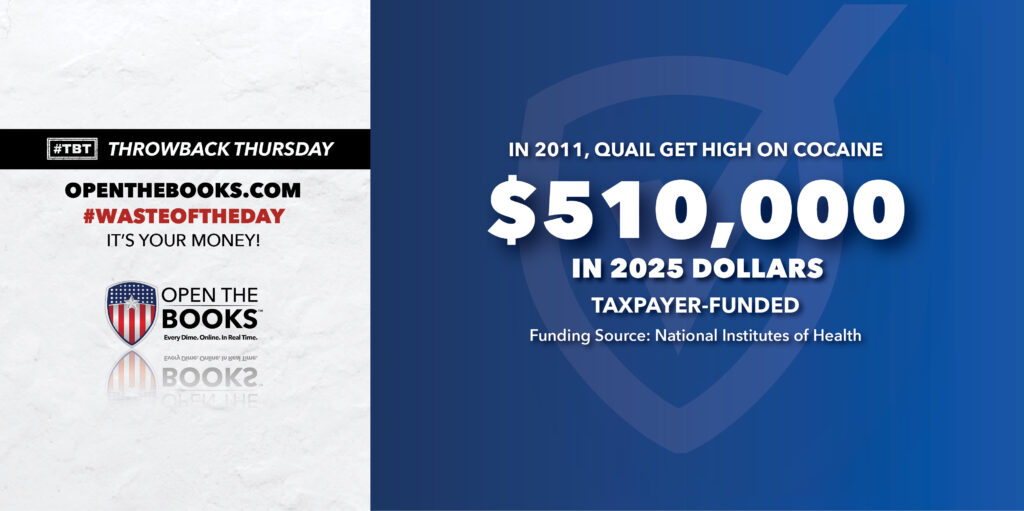
Coburn’s Wastebook 2011 included 100 examples of outrageous spending worth nearly $7 billion, including the money to study birds’ drug preferences — which would be worth $510,000 today.
Search all federal, state and local salaries and vendor spending with the world’s largest government spending database at OpenTheBooks.com.
Key facts: The full study, titled “Cocaine induces state-dependent learning of sexual conditioning in male Japanese quail,” was not published until November 2014. The findings were applied to humans to analyze whether “repeated cocaine use” increases “high risk sexual activities, including sex with multiple partners and unprotected sex.”
Materials and methods
For two weeks, a group of male quail was injected with 10 milligrams of cocaine every day. Then, the scientists timed how many seconds the birds spent near female quail. The results showed that quail who had been on cocaine for two weeks had “greater sexual conditioning” and were more likely to seek out females compared to birds who were using cocaine for the very first time.
Japanese quail were chosen instead of rats or pigeons because they “readily engage in reproductive behavior in the laboratory.”
Supporting quote: CNSNews.com asked the NIH in 2011,
The Census Bureau says the median household income in the United States is $52,000. How would you explain to the average American mom and dad — who make $52,000 per year — that taxing them to pay for this grant was justified?
NIH spokesman Don Rabovsky explained,
The development of effective interventions for risky behaviors depends on a robust scientific foundation of behavioral research that: Identifies the psychological, social, and cultural mechanisms of risk-taking behaviors and, as a result, provides insights into how those behaviors can be modified through interventions that target individual choices and the social, economic, policy, and cultural contexts in which those choices are made.
Most taxpayers would likely consider that a very vague explanation for an oddly specific research project.
Summary: When government funds are spent on cocaine for quail, it’s fair to wonder what the NIH officials who approved the study were smoking.
The #WasteOfTheDay is brought to you by the forensic auditors at OpenTheBooks.com.
This article was originally published by RealClearInvestigations and made available via RealClearWire.

Jeremy Portnoy, former reporting intern at Open the Books, is now a full-fledged investigative journalist at that organization. With the death of founder Adam Andrzejewki, he has taken over the Waste of the Day column.





-

 Civilization3 days ago
Stealth, Sensors, and Staying Power: What the F-35 Just Proved—and What Comes Next
-

 Executive3 days ago
Citizen Sleuths Spotlight Red Flags Galore in Government Spending
-

 Guest Columns4 days ago
Oklahoma’s Digital Future Will Be Built on Affordable, Reliable, Clean Energy Security
-

 Executive5 days ago
Waste of the Day: Throwback Thursday – Helping Beverly Hills’ Low-Income Community
-

 Civilization2 days ago
Dems Scramble After California Governor’s Debate Implodes
-

 Civilization3 days ago
Waste of the Day: Cybersecurity Programmers Have Foreign Ties
-
 Executive3 days ago
A Consent Decree for Freedom of Speech
-
 Executive2 days ago
America’s $130 Trillion Blind Spot