
Education
Waste of the Day: Throwback Thursday: Grant Goes to Guppy Video Game
In 2011, the National Science Foundation awarded a federal grant to a California university to develop a video game to teach evolution.



Topline: Plenty of American children were playing mobile games like Angry Birds and Minecraft in 2011, but those only cost a few dollars. Taxpayers were billed nearly $150,000 to help develop RapidGuppy, an educational science video game created by researchers at the University of California-Riverside. The money would be worth $214,000 today.
A federal grant to develop a video game?
That’s according to the “Wastebook” reporting published by the late U.S. Senator Dr. Tom Coburn. For years, these reports shined a white-hot spotlight on federal frauds and taxpayer abuses.
Coburn, the legendary U.S. Senator from Oklahoma, earned the nickname “Dr. No” by stopping thousands of pork-barrel projects using the Senate rules. Projects that he couldn’t stop, Coburn included in his oversight reports.
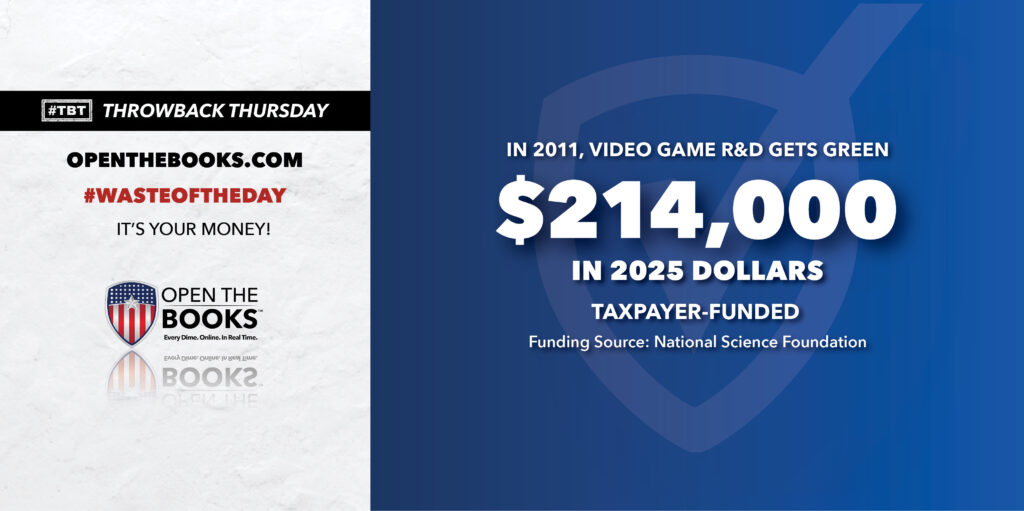
Coburn’s Wastebook 2011 included 100 examples of outrageous spending worth nearly $7 billion, including the video game development money.
Key facts: The $150,000 federal grant was awarded by the National Science Foundation to create a phone app based on the Trinidadian guppy, a species that can rapidly evolve in just three to five years. The app was targeted at “youth who are prone to play electronic games.” Coupled with a “major social media campaign,” the game was meant to “increase the level of interest in the science of evolution and genetic change.”
The public funding seems unnecessary in hindsight. RapidGuppy’s creators already had investments from several private companies, including MagMic Inc. — an app developer with over $10 million in annual revenue at the time.
Search all federal, state and local salaries and vendor spending with the world’s largest government spending database at OpenTheBooks.com.
The game proponents offer a straw man argument
The app’s inclusion in the Wastebook earned a rebuke from scientific journalist Michelle Clement, who ran an opinion piece in Scientific American called “The Guppy Project is not wasteful, Sen. Coburn.” She compared the app to other educational games like Math Blasters and Mario Teaches Typing and accused Coburn of opposing the theory of evolution.
Summary: Guppies can evolve in just three to five years, but the federal government’s wasteful spending habits have not changed for decades.
The #WasteOfTheDay is brought to you by the forensic auditors at OpenTheBooks.com.
This article was originally published by RealClearInvestigations and made available via RealClearWire.

Jeremy Portnoy, former reporting intern at Open the Books, is now a full-fledged investigative journalist at that organization. With the death of founder Adam Andrzejewki, he has taken over the Waste of the Day column.





-

 Civilization3 days ago
Stealth, Sensors, and Staying Power: What the F-35 Just Proved—and What Comes Next
-

 Executive3 days ago
Citizen Sleuths Spotlight Red Flags Galore in Government Spending
-

 Guest Columns4 days ago
Oklahoma’s Digital Future Will Be Built on Affordable, Reliable, Clean Energy Security
-

 Civilization2 days ago
Dems Scramble After California Governor’s Debate Implodes
-

 Executive5 days ago
Waste of the Day: Throwback Thursday – Helping Beverly Hills’ Low-Income Community
-

 Civilization4 days ago
Waste of the Day: Cybersecurity Programmers Have Foreign Ties
-
 Executive4 days ago
A Consent Decree for Freedom of Speech
-

 Executive2 days ago
America’s $130 Trillion Blind Spot