
Executive
Waste of the Day: Questions Arise Over $5.8 Billion in Rental Assistance
The Department of Housing and urban Development might have let shady groups defraud its rental assistance program of up to $5.8 billion.



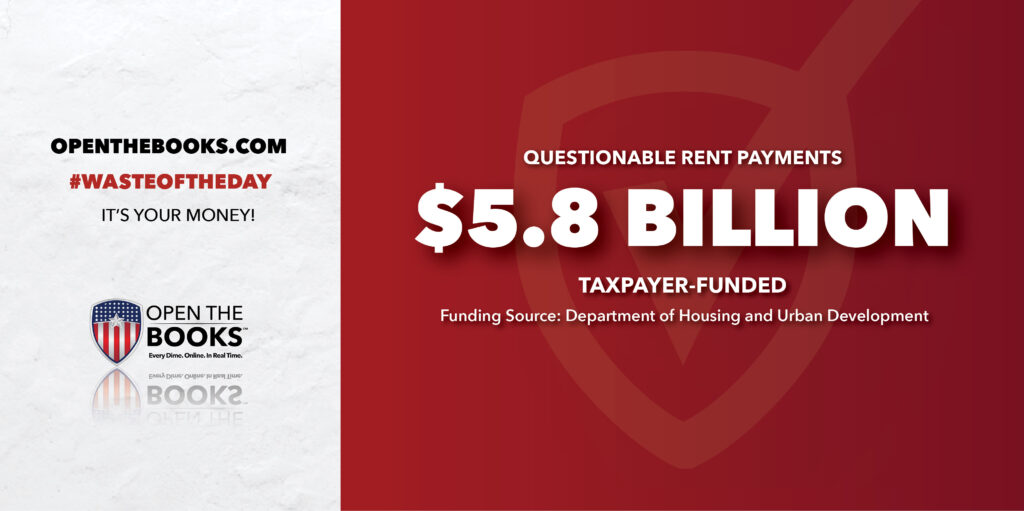
Topline: The federal government is unable to verify that $5.8 billion in rental assistance paid to more than 204,000 recipients in 2024 was not fraudulent, according to the Department of Housing and Urban Development’s latest annual report.
Rental assistance programs raise red flags
Key facts: HUD spent $15.2 billion on project-based rental assistance in 2024, which pays local housing authorities or private businesses and nonprofits to build affordable housing. That included $4.3 billion in “questionable payments” to nearly 113,000 groups that may have been ineligible for funding, according to the financial report — a mistake rate of over 26%.
HUD also gave $33.9 billion directly to families to help with rent payments, but the financial report claims $1.5 billion sent to almost 92,000 people was “questionable.” The estimates include $77 million paid to 29,715 dead people and $150.3 million paid to 9,472 people with invalid Social Security numbers.
But most of the flagged payments — $5.2 billion — were sent to people or businesses with inactive registrations in the System for Award Management. The federal government is generally not supposed to pay money to anyone not registered on SAM.gov. The online platform allows officials to ensure that a business is legitimate, not a fictional company trying to steal money from the government.
Most of the recipients that did not register on SAM.gov were likely legitimate businesses that mistakenly did not follow federal procedure, not organized criminals intentionally breaking the law. Contrary to viral claims on social media, the payments are not all known to be fraudulent.
Why didn’t they use an obvious tool?
Still, HUD would have been able to better screen applicants if it was using the Treasury’s Do Not Pay list, which tracks entities with missing paperwork, debt to the government, a history of fraud and more.
The software agreement that gave HUD access to the list expired in 2019, during President Donald Trump’s first term. It remained inactive throughout Joe Biden’s time as president and was not renewed until May 2025, according to HUD’s inspector general, who blamed both presidents for “weak governance around Do Not Pay implementation” in a May 2025 report.
In 2024, HUD sent $212 million to 11 entities on the Do Not Pay list, the inspector general found.
Search all federal, state and local salaries and vendor spending with the world’s largest government spending database at OpenTheBooks.com.
Background: In its latest financial report, HUD relied on what it called “innovative methods and advanced analytics” to analyze millions of payment records, unlike past audits that use a sample of a few hundred records.
HUD also announced it will publish full estimates of improper payments from its two largest rental assistance programs, as required by the Payment Integrity Information Act of 2019. The estimates have never been completed because of “a lack of necessary data, no effective technology platform for collecting supporting documentation, and unsuccessful attempts to manually review information,” according to the financial report.
Limited estimates released in 2024 identified just $45 million in unknown payments from HUD’s rental assistance programs.
Summary
Summary: Every oversight gap in safety net programs makes it more difficult to ensure public funds are reaching the people who are legally entitled to them.
The #WasteOfTheDay is brought to you by the forensic auditors at OpenTheBooks.com
This article was originally published by RealClearInvestigations and made available via RealClearWire.

Jeremy Portnoy, former reporting intern at Open the Books, is now a full-fledged investigative journalist at that organization. With the death of founder Adam Andrzejewki, he has taken over the Waste of the Day column.





-
 Civilization4 days ago
Winning in Iran Requires More Than Military Success
-

 Civilization4 days ago
Epic Fury as It Is: A Look Inside
-

 Guest Columns4 days ago
Waste of the Day: $34 Billion In Secretive Military Funding
-

 Civilization5 days ago
America Needs to Understand Golden Dome Before It’s Too Late
-

 Education2 days ago
Waste of the Day: School Officials Claim Safari Was “Professional Development”
-

 Civilization5 days ago
Becca Rothfeld’s Fanciful Demands of Liberalism
-

 Executive3 days ago
Hell No, We Won’t Go!: A Florida Man’s Response to NY’s Gov. Hochul
-

 Executive2 days ago
Waste of the Day: Throwback Thursday – Crash Landing for NASA Video Game