
Education
Waste of the Day: Students Lose in North Carolina’s Lottery
The North Carolina lottery was supposed to fund education, but only 16 percent of “house winnings” have gone to schools.


Topline: North Carolina’s state website claims that about 30% of the revenue from lottery tickets helps fund public schools. Yet despite record-breaking sales, that has not been true in years, according to a new state audit. Just 16% of lottery revenue from fiscal year 2025 will go toward education, auditors claim.
North Carolina lottery breaks its promise
Key facts: North Carolina legalized lottery tickets in 2005 with a requirement that 35% of all revenue would be invested in public education. The money is used for school construction, college scholarships, teacher salaries and more.
The requirement was changed to a “guideline” in 2007, and the percentage of lottery revenue that makes it to schools has been declining ever since.
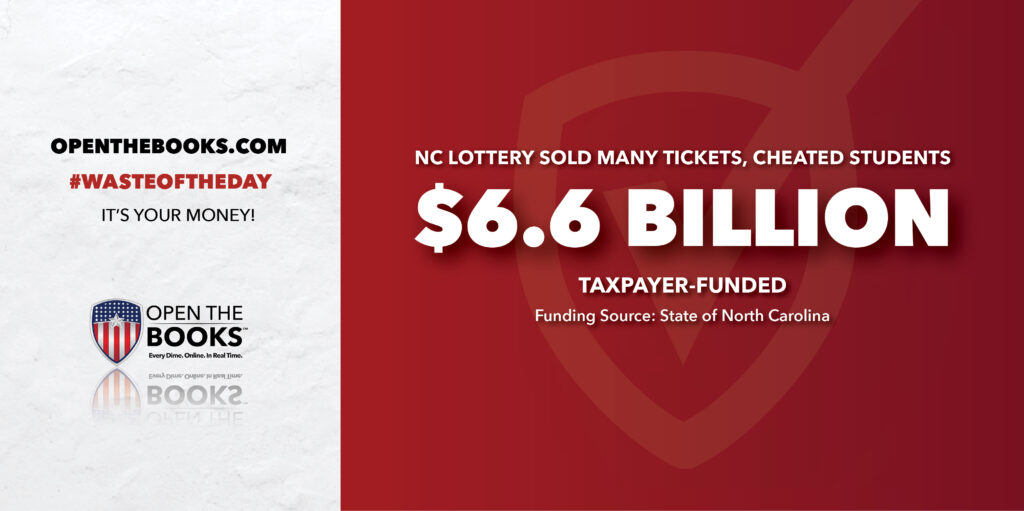
North Carolina sold a record $6.6 billion worth of lottery tickets in 2025, a huge increase from the $5.4 billion sold in 2024.
However, prize money also increased. Financial statements show North Carolina paid $5 billion to lottery winners in 2025.
Commissions for retail stores that sell lottery tickets cost $269 million. Lottery officials also spent $2.3 million on rent for office space and bought $2.2 million worth of furniture and equipment, an increase of more than $1 million compared to 2024. Employee travel cost $377,000.
After all the expenses were paid, there was just $1.1 billion left for public education investments. That was barely more than in 2021, when the state sold only $3.8 billion in lottery tickets.
Rising salaries have also increased the lottery agency’s expenses. Salaries and benefits cost almost $40 million in 2025, an increase of nearly $6 million from 2024, according to the audit. There were five people earning a salary of $200,000 or more in 2024, including $281,459 for Lottery CEO Michael Machalko.
Excuses, excuses
In its response to the audit, the North Carolina Education Lottery blamed its high expenses on the surging popularity of digital lottery games. Digital games typically have higher prizes than draw games like the Powerball, meaning the state gets to keep less of the revenue. Even though overall lottery sales are up, sales at brick-and-mortar retail stores are declining.
Search all federal, state and local salaries and vendor spending with the world’s largest government spending database at OpenTheBooks.com.
Critical quote: “Let me point out: that is cumulative $3 billion in additional revenue over the previous two fiscal years with relatively flat contributions to public schools,” State Auditor Dave Boliek told WXII12. “The real question that needs to be asked on behalf of the people of North Carolina is: explain the business model.”
Summary: Education funding should be based on sound investments, not luck of the draw.
The #WasteOfTheDay is brought to you by the forensic auditors at OpenTheBooks.com.
This article was originally published by RealClearInvestigations and made available via RealClearWire.

Jeremy Portnoy, former reporting intern at Open the Books, is now a full-fledged investigative journalist at that organization. With the death of founder Adam Andrzejewki, he has taken over the Waste of the Day column.








-

 Civilization4 days ago
How Prepared Is the Defense Industrial Base for Iranian Cyber Attacks?
-

 Civilization5 days ago
Does the Donroe Doctrine Now Extend to Outer Space?
-

 Civilization2 days ago
Stealth, Sensors, and Staying Power: What the F-35 Just Proved—and What Comes Next
-

 Civilization5 days ago
Imminent Threat? Iran Was Existential Threat
-

 Civilization4 days ago
No Retreat, No Surrender: Why America Must Prevail in Iran
-

 Executive2 days ago
Citizen Sleuths Spotlight Red Flags Galore in Government Spending
-

 Guest Columns3 days ago
Oklahoma’s Digital Future Will Be Built on Affordable, Reliable, Clean Energy Security
-

 Education5 days ago
Waste of the Day: AZ School Vouchers Used For Hot Tub, Wedding Gifts, More