
Executive
Waste of the Day: Unclear Goal for Digital Inclusion Grants
The Washington State Department of Commerce awarded grants for equitable digital inclusion, grants they did little or nothing to oversee.



Topline: The Washington State Department of Commerce ignored “the fundamental tenets of government accountability” by awarding grants that lacked a clear purpose, according to a Jan. 27 report from State Auditor Pat McCarthy.
Grants went to vague and indecipherable purposes
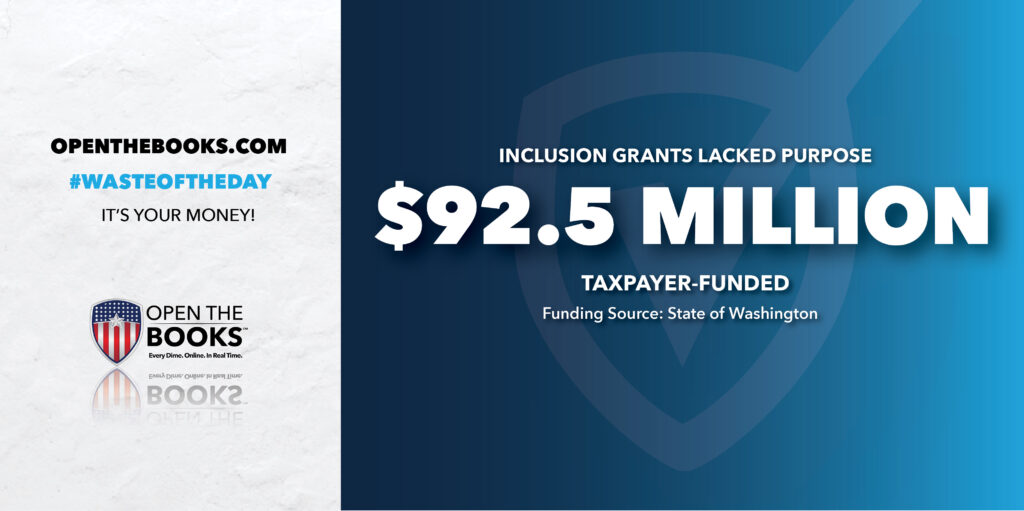
Key facts: The spending came from the state’s Digital Navigator Program, which spent $92.5 million from 2022 to 2025 to advance “equitable digital inclusion.” That included internet subscriptions and education classes for groups like seniors and low-income families who might struggle to access online services like telehealth and job applications.
Anyone who finds that description vague is not alone. McCarthy argued it was “unclear what grantees were expected to produce or when.”
Grantees were required to submit monthly reports listing their goals accomplished, but they were not required to report whether they accomplished them. The program’s online dashboard was also “unsuitable for evaluating effectiveness” because it did not measure what seniors and low-income families learned from the program, according to the audit.
One grantee never submitted any data at all, citing “tribal data sovereignty rules.” Another stopped submitting data halfway through the program “due to concerns about data security and methodology.” When data did get submitted, the state did not check its accuracy.
Auditors also found that the program had no formal policies for choosing which companies and nonprofits received grants. Internal documents from 2024 show that officials ranked 18 grant applicants based on scores that “lacked explanations.” Then, officials chose three applicants to receive grants — including the company with the lowest score.
Grantees had little or not oversight of their spending
Once the grants were paid, the recipients could then hire other companies with little to no oversight or vetting, the audit found. That allowed $500,000 to end up with a company that later closed down following an unrelated investigation into suspected fraud.
State budget cuts forced the Digital Navigator Program to close this year.
Search all federal, state and local salaries and vendor spending with the world’s largest government spending database at OpenTheBooks.com.
Background: The audit placed blame on “the two directors leading the agency between February 2019 and December 2024,” presumably former Department of Commerce directors Lisa Brown and Mike Fong.
Brown earned $194,300 as director in 2022 and departed in 2023. Fong replaced her and earned $217,400 in 2024.
The Washington Department of Commerce also received a $16 million federal grant in 2021 to advance digital equity, but at least a portion of it was canceled in May 2025. The Trump administration argued it was approved using “unconstitutional racial preferences.”
Summary: If the Digital Navigator Program’s directors have a lot to learn about responsible spending, which begins with not awarding grants without strict oversight.
The #WasteOfTheDay is brought to you by the forensic auditors at OpenTheBooks.com.
This article was originally published by RealClearInvestigations and made available via RealClearWire.

Jeremy Portnoy, former reporting intern at Open the Books, is now a full-fledged investigative journalist at that organization. With the death of founder Adam Andrzejewki, he has taken over the Waste of the Day column.








-

 Civilization4 days ago
FBI Misled Court To Spy on Second Trump Campaign Adviser
-
 Civilization2 days ago
Election Reform Republicans Can Actually Pass
-

 Education4 days ago
Waste of the Day: Failing Texas School Paid Supt. $900K
-

 Civilization4 days ago
Secret Service Agent Faulted for Butler Failures Suspended Again
-

 Civilization4 days ago
A New Way to Measure U.S. Energy Security
-

 Civilization4 days ago
Times of Conflict or War Remind Us of the Importance of U.S. Natural Gas
-

 Civilization2 days ago
Redefining Strategy in the High North: Wargaming a Contested Arctic
-

 Civilization3 days ago
Paul Ehrlich Wasn’t Premature: He Was Wicked