
Executive
Waste of the Day: States Spent Welfare in “Crazy Ways”
Different States have used the welfare program Temporaryh Assistance to Needy Families to finance many things other than needy families.



Topline: The federal welfare program, Temporary Assistance for Needy Families, is sending less money directly to families and more to nonprofits and state agencies, leading the Wall Street Journal to label it a “slush fund” in a new analysis.
How a popular federal welfare program became a slush fund for States – and nonprofits
Key facts: TANF exists to help low-income families with children pay for housing, groceries, child care and more. The program is part of the Office of the Administration for Children & Families, under the U.S. Department of Health & Human Services, and awards $16.5 billion annually to be managed by states.
But the number of families directly benefitting from the program is declining, according to federal data reviewed by the Wall Street Journal. In 1999, there were more than 2.5 million families that received cash payments from TANF in an average month. In 2025, there were only 849,000.
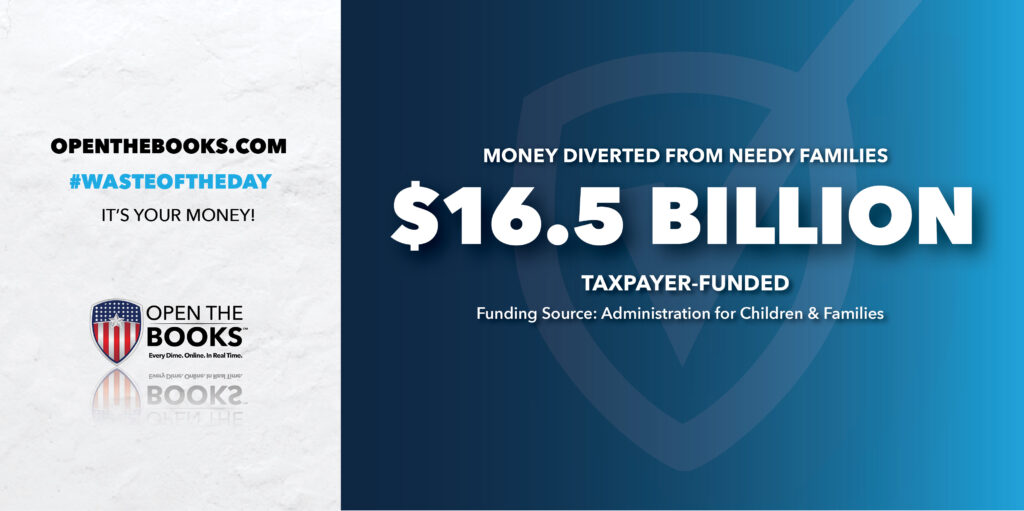
That does not mean the program is getting cheaper or that families no longer need assistance. Instead, states are spending most of their TANF money on nonprofits and programs that sometimes have only “tenuous — or no — connections to TANF’s goals,” the Wall Street Journal claims.
Ann Flagg, who led the TANF program under President Joe Biden, told the Wall Street Journal she saw “many, many instances … that funds were used in crazy ways.”
Some states like Texas spend less than 2% of their TANF funding on basic assistance to needy families, the Wall Street Journal reported.
A 2020 audit found Mississippi spent $5 million inn TANF funds on a new volleyball stadium and paid NFL quarterback Brett Favre $1 million for a speaking engagement that he never attended. He later repaid the money.
More examples
A 2025 audit in Louisiana found that for 13 years, the state didn’t properly track whether TANF recipients were working at least 30 hours a week, as required by federal law.
Missouri has $12 million in TANF funding set aside this year to fund antiabortion advocacy and health programs. A state spokesperson told the Wall Street Journal the money will fulfill TANF’s goal of helping families care for children.
The White House, by design, has very little oversight of how states spend their TANF money. The program was originally touted by the GOP as a way to give states more flexibility in welfare spending and avoid burdensome requirements from Washington.
Analysts on both sides of the aisle agree that the limited oversight has caused problems.
Robert Rector, who helped draft the bill that created TANF in 1996 and is now a fellow at the Heritage Foundation, told the Wall Street Journal that “all states are in de facto violation of the law” because their spending does not align with TANF’s goals.
Nick Gwyn of the left-leaning Center on Budget and Policy Priorities said, “The program has drifted away from the core purpose of supporting families with very little income.”
Search all federal, state and local salaries and vendor spending with the world’s largest government spending database at OpenTheBooks.com.
Amounts changed little over 30 years
Background: The White House spends $16.5 billion on TANF every year. The amount has barely changed since TANF was created in 1996, even though it’s worth less today due to inflation.
President Donald Trump is currently attempting to freeze some TANF funding in five Democratic states — California, Colorado, Illinois, New York and Minnesota — citing nonspecific fraud concerns. However, the Wall Street Journal’s analysis noted that both red and blue states are guilty of misusing their TANF money.
Summary: When both Democrats and Republicans agree that a program needs to be reformed, there can be little doubt that change is necessary.
The #WasteOfTheDay is brought to you by the forensic auditors at OpenTheBooks.com.
This article was originally published by RealClearInvestigations and made available via RealClearWire.

Jeremy Portnoy, former reporting intern at Open the Books, is now a full-fledged investigative journalist at that organization. With the death of founder Adam Andrzejewki, he has taken over the Waste of the Day column.






-

 Civilization4 days ago
How Prepared Is the Defense Industrial Base for Iranian Cyber Attacks?
-

 Civilization2 days ago
Stealth, Sensors, and Staying Power: What the F-35 Just Proved—and What Comes Next
-
 Civilization4 days ago
No Retreat, No Surrender: Why America Must Prevail in Iran
-

 Executive2 days ago
Citizen Sleuths Spotlight Red Flags Galore in Government Spending
-

 Guest Columns3 days ago
Oklahoma’s Digital Future Will Be Built on Affordable, Reliable, Clean Energy Security
-
 Education5 days ago
Waste of the Day: AZ School Vouchers Used For Hot Tub, Wedding Gifts, More
-

 Executive4 days ago
Waste of the Day: Throwback Thursday – Helping Beverly Hills’ Low-Income Community
-

 Civilization1 day ago
Dems Scramble After California Governor’s Debate Implodes