
Executive
Waste of the Day: Wire Fraud, Conflicts of Interest in Connecticut
A nonprofit in Connecticut took taxpayers’ money and couldn’t even keep track of its funds, losing $300,000 to wire fraud.


Topline: A taxpayer-funded Connecticut nonprofit closed down after a state audit found it lost $300,000 to wire fraud, gave a grant to an employee, and had no records to prove that another $1.3 million was spent properly.
How a Connecticut nonprofit scammed the State
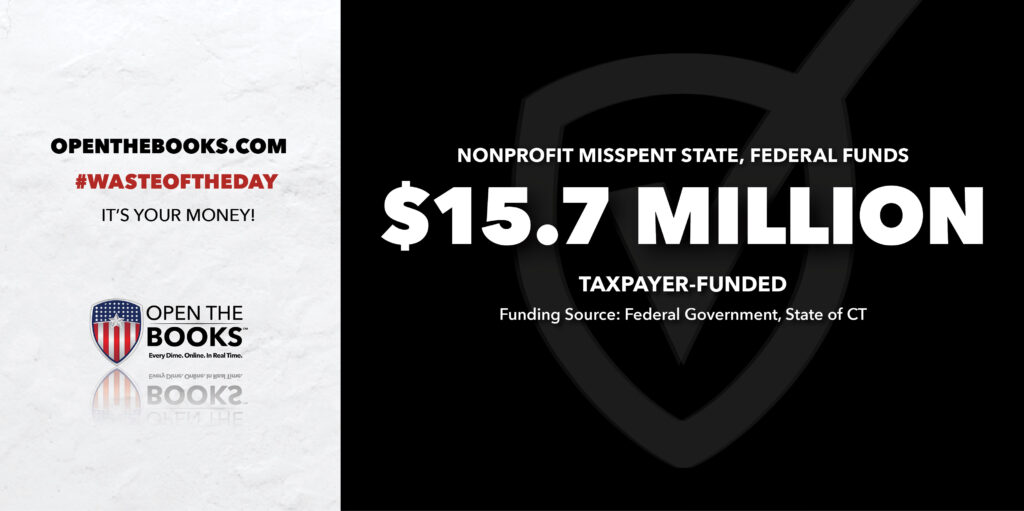
Key facts: The Blue Hills Civic Association supported community empowerment through youth programs, housing assistance and more. They received $15.7 million in state and federal funds from 2022 to 2025, including $5.5 million last year.
Open the Books previously reported on an audit that found that State Sen. Doug McCrory directed Blue Hills to send state funds to his alleged live-in girlfriend, who never performed the work she was paid for. The same audit also found several other problems Blue Hills created while dispersing grants to other nonprofits.
In September 2024, Blue Hills chose the My People Community Services mental health support group to receive a $300,000 state grant
Seven days later, Blue Hills received an email from a fraudster posing as My People Community Services, using the email domain “My Peoples” instead of “My People.” The email included a bank account number, and Blue Hills wired over the full $300,000.
It wasn’t until December that My People Community Services told Blue Hills they had never received the money, and the error was discovered, according to the audit.
Details of a flawed grant
Blue Hills also gave a $15,000 grant to a local church to run a chess program for kids. Dr. Ken Torell Berry approved the grant on behalf of the church, then taught the program himself and pocketed at least some of the money, according to auditors.
The $15,000 included a $7,000 fee for a “program manager” — Berry’s job title — and $1,000 for his transportation, which auditors questioned. Berry lives near the church, so transportation expenses were seemingly unnecessary. Blue Hills never asked Berry to submit any receipts showing what transportation he used.
In June 2024, Blue Hills hired Berry as an employee. Then they awarded him a $25,000 grant to run his chess program again in 2025, which the auditors called a “clear conflict of interest.”
Blue Hills used another $1.3 million from the state on its operational expenses in 2025, but the nonprofit kept no receipts to show what the money paid for.
“As a result, no records were available to demonstrate how the $1.258 million was used or whether these costs were allowable or directly related to [Blue Hills’] grant programs,” the auditors wrote.
Summary: Wire fraud and chess require complex plans, but fiscal responsibility only needs basic planning and accountability.
The #WasteOfTheDay is brought to you by the forensic auditors at OpenTheBooks.com.
This article was originally published by RealClearInvestigations and made available via RealClearWire.

Jeremy Portnoy, former reporting intern at Open the Books, is now a full-fledged investigative journalist at that organization. With the death of founder Adam Andrzejewki, he has taken over the Waste of the Day column.










-

 Civilization5 days ago
Dems Scramble After California Governor’s Debate Implodes
-

 Executive5 days ago
America’s $130 Trillion Blind Spot
-

 Civilization4 days ago
Iran Could Reshape the Middle East and the Global Balance of Power
-

 Civilization3 days ago
The conversation women are having
-

 Executive3 days ago
Waste of the Day: NYC Thermostat Repairers Made $325K, Thanks to OT
-

 Executive4 days ago
The Assisted Suicide of Lofty State and Local Taxes
-

 Civilization2 days ago
Epic Fury as It Is: A Look Inside
-

 Civilization3 days ago
America Needs to Understand Golden Dome Before It’s Too Late