
Executive
Waste of the Day: Prediction: Debt Will Soon Break Record
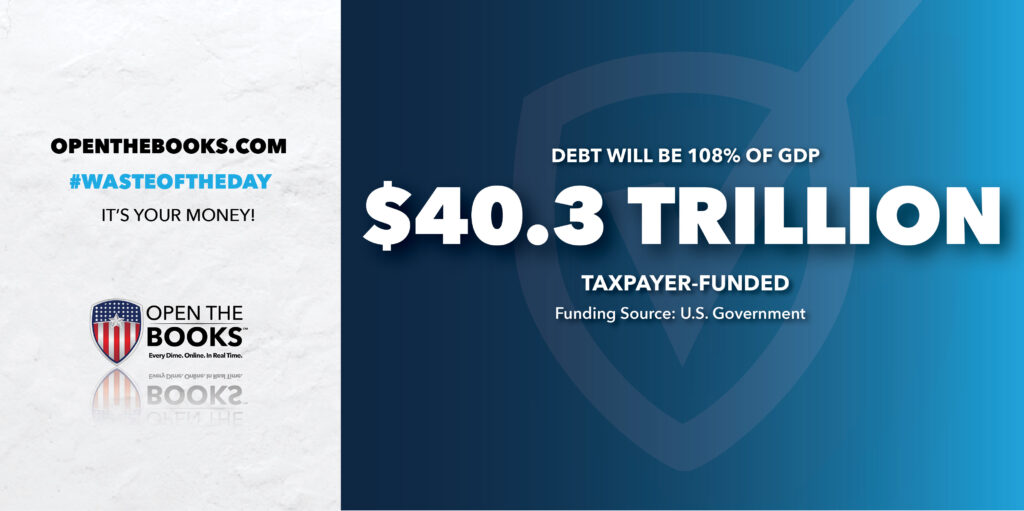
The federal debt held by the public will soon exceed 108 percent of Gross Domestic Product, thus setting a record.



Topline: The Congressional Budget Office’s annual 10-year economic forecast warns that, by 2030, the federal debt held by the public will be $40.3 trillion, or 108% of the country’s gross domestic product — an amount never before seen in American history.
Distinction of the federal debt held by the public
Key facts: The federal debt held by the public differs slightly from the overall federal debt because it excludes money that government agencies owe to each other. Most economists consider it a more meaningful statistic. It reached $30.2 trillion in 2025, the CBO notes.
By 2036, it will be even higher: the debt held by the public will be $56.2 trillion, the CBO predicts. That would be 120% of GDP. It has never been higher than 106%.
The debt is expected to grow because, under current policy, the U.S. will spend $24.2 trillion more than it collects from taxes and other revenue from 2027 to 2036, according to the CBO.
The CBO’s estimates assume that military spending will only increase slightly, but President Donald Trump has already called for the defense budget to increase by roughly 67% next year. If that happened without corresponding spending cuts, the U.S. would take on another $5.8 trillion of debt by 2036, according to the Committee for a Responsible Federal Budget.
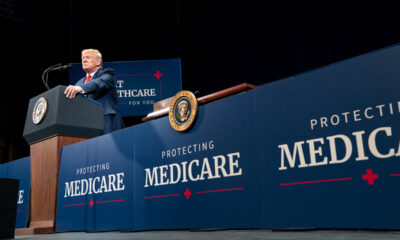
The CBO also predicts the cost of Medicare will almost double to $2 trillion per year by 2036. Inflation is expected to be 2.8% this year, an “elevated” level caused by tariffs, according to the CBO. The estimate was published before the Supreme Court struck down most of the tariffs Trump created in 2025, though the president has vowed to restore them within five months.
The economy is still growing overall
Still, the CBO now expects the American economy to grow at a faster rate than originally predicted in 2025. Even though the CBO said it expected tariffs to reduce consumer spending and slow economic growth, that will be more than offset by tax cuts in the One Big Beautiful Bill Act. The wealthiest 10% of households are expected to have an extra $14,000 of spending money per year that can be used on American products.
However, the poorest 20% of households are expected to have less spending money because of cuts to programs like Medicaid and food stamps.
Search all federal, state and local salaries and vendor spending with the world’s largest government spending database at OpenTheBooks.com.
Summary: With every passing year, the federal debt crisis becomes less of an abstract, faraway problem and more of an immediate concern.
The #WasteOfTheDay is brought to you by the forensic auditors at OpenTheBooks.com
This article was originally published by RealClearInvestigations and made available via RealClearWire.

Jeremy Portnoy, former reporting intern at Open the Books, is now a full-fledged investigative journalist at that organization. With the death of founder Adam Andrzejewki, he has taken over the Waste of the Day column.





-

 Civilization5 days ago
How Prepared Is the Defense Industrial Base for Iranian Cyber Attacks?
-

 Civilization3 days ago
Stealth, Sensors, and Staying Power: What the F-35 Just Proved—and What Comes Next
-
 Executive3 days ago
Citizen Sleuths Spotlight Red Flags Galore in Government Spending
-

 Civilization5 days ago
No Retreat, No Surrender: Why America Must Prevail in Iran
-

 Guest Columns4 days ago
Oklahoma’s Digital Future Will Be Built on Affordable, Reliable, Clean Energy Security
-

 Civilization2 days ago
Dems Scramble After California Governor’s Debate Implodes
-

 Executive4 days ago
Waste of the Day: Throwback Thursday – Helping Beverly Hills’ Low-Income Community
-
 Executive3 days ago
A Consent Decree for Freedom of Speech