
Executive
Waste of the Day: Throwback Thursday – Gigantic Internet Routers for One Computer
West Virginia bought over 1000 oversized Internet routers, each capable of handling tens of thousands of users – to handle one machine each.,



Topline: West Virginia government officials spent $24 million in 2010 on expensive, high-capacity internet routers that could handle tens of thousands of users at once. Then, they placed them in libraries and schools that only had one computer in the entire building.
Big routers serving one computer each?
That’s according to the “Wastebook” reporting published by the late U.S. Senator Dr. Tom Coburn. For years, these reports shined a white-hot spotlight on federal frauds and taxpayer abuses.
Coburn, the legendary U.S. Senator from Oklahoma, earned the nickname “Dr. No” by stopping thousands of pork-barrel projects using the Senate rules. Projects that he couldn’t stop, Coburn included in his oversight reports.
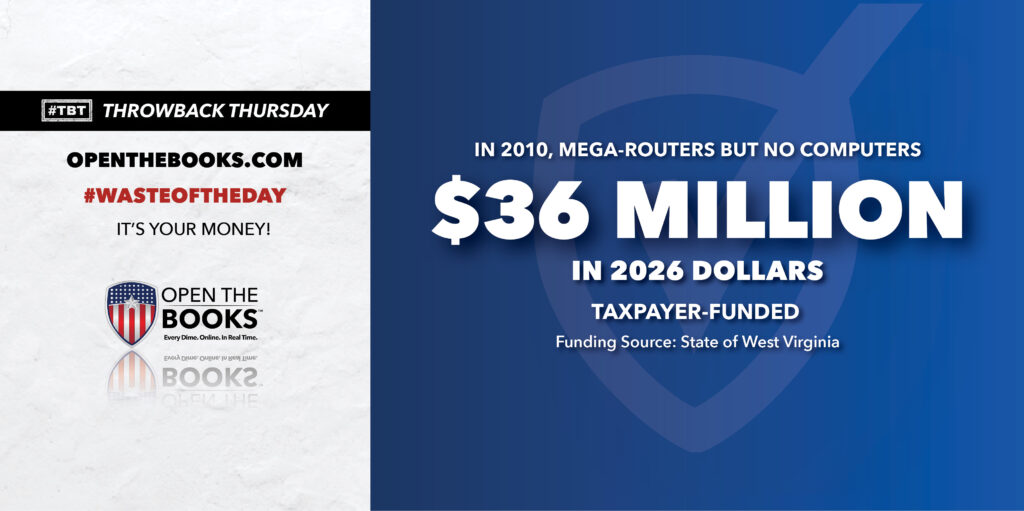
Coburn’s Wastebook 2012 included 100 examples of outrageous spending worth more than $18 billion, including West Virginia’s needlessly large internet routers — which would be worth $36 million today.
Key facts: The State of West Virginia bought more than 1,000 routers for $22,600 each using federal grant funds from the Department of Commerce. Each one was meant to allow at least 500 devices to connect to the internet simultaneously and would ordinarily be placed in a university campus or convention center.
Seventy percent of the routers went to rural schools and libraries, none of which had more than a few computers.
Members of then-Gov. Earl Ray Tomblin’s administration tried to claim the buildings would eventually get more computers, but a state audit later found there was no realistic scenario where the routers would ever be necessary. State officials could have met all of the buildings’ internet needs with routers costing just $6,335 each, according to the audit.
New shelves to hold oversized routers
Karen Goff, West Virginia’s library commissioner at the time, said some libraries were constructing new shelves because they could not fit the huge routers inside their buildings.
The routers were also sent to 10 state offices that each had eight employees or less. Lea Wolfe, the director of one of the offices, told the Charleston Gazette-Mail she tried to send the router back because it was too big. The state sent another one and told Wolfe her office was required to use it.
“It’s now in the hallway under a table covered with papers,” Wolfe said. “I have a $22,000 router that’s collecting dust … We don’t know what to do with them. We never asked for them.”
A consultant suggested an overkill purchase – and the government made it
West Virginia bought the routers from the technology company Cisco, whose employees showed a “wanton indifference to the interests of the public” by recommending such an expensive purchase, according to the state audit.
Each router came with a $1,220 security plan for the Voice Over Internet Phone system, which allows phone calls to be made online. Auditors later found that an estimated 51% of buildings that received the routers did not have a Voice Over Internet Phone system.
Search all federal, state and local salaries and vendor spending with the world’s largest government spending database at OpenTheBooks.com.
Summary: With its powerful routers, thousands of West Virginia officials can access the internet simultaneously and research responsible ways to spend taxpayer money.
The #WasteOfTheDay is brought to you by the forensic auditors at OpenTheBooks.com.
This article was originally published by RealClearInvestigations and made available via RealClearWire.

Jeremy Portnoy, former reporting intern at Open the Books, is now a full-fledged investigative journalist at that organization. With the death of founder Adam Andrzejewki, he has taken over the Waste of the Day column.








-

 Civilization5 days ago
Stealth, Sensors, and Staying Power: What the F-35 Just Proved—and What Comes Next
-

 Executive5 days ago
Citizen Sleuths Spotlight Red Flags Galore in Government Spending
-

 Civilization4 days ago
Dems Scramble After California Governor’s Debate Implodes
-

 Executive4 days ago
America’s $130 Trillion Blind Spot
-

 Civilization3 days ago
Iran Could Reshape the Middle East and the Global Balance of Power
-

 Civilization2 days ago
The conversation women are having
-
 Executive2 days ago
Waste of the Day: NYC Thermostat Repairers Made $325K, Thanks to OT
-

 Executive3 days ago
The Assisted Suicide of Lofty State and Local Taxes