
Executive
Waste of the Day: Throwback Thursday – NSF Funded “Prom Week” Video Game
In 2012 the National Science Foundation funded the creation of a video game called prom week, with AI (artificial intelligence) players.



Topline: In 2012, artificial intelligence researchers funded by the federal government were not concerned whether their technology could interpret data or streamline workflows. They wanted to know if AI could navigate the high school dating scene.
The NSF grant for an AI prom week simulation
The University of California, Santa Cruz, used part of a $516,000 National Science Foundation grant to create “Prom Week,” a video game that simulated teenagers trying to get a date to the school dance. The grant would be worth $740,000 today.
That’s according to the “Wastebook” reporting published by the late U.S. Senator Dr. Tom Coburn. For years, these reports shined a white-hot spotlight on federal frauds and taxpayer abuses.
Coburn, the legendary U.S. Senator from Oklahoma, earned the nickname “Dr. No” by stopping thousands of pork-barrel projects using the Senate rules. Projects that he couldn’t stop, Coburn included in his oversight reports.
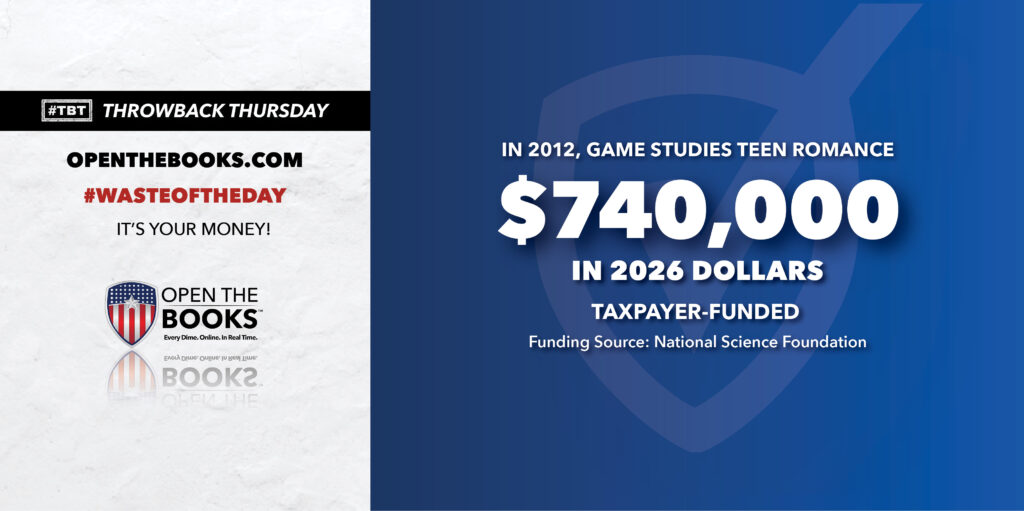
Coburn’s Wastebook 2012 included 100 examples of outrageous spending worth more than $18 billion, including AI-generated high school drama.
Search all federal, state and local salaries and vendor spending with the world’s largest government spending database at OpenTheBooks.com.
Key facts: The NSF grant was meant for “serious games (games for education and training) that focus on people-to-people interaction, such as management training, and public service games that tackle complex topics such as racism.”
As if that wasn’t odd enough, UC Santa Cruz’s Center for Games and Playable Media used their cut of the money to create what they called “the first game that actually lets you play things like friendship and backstabbing, romance and cruelty.”
Players could control 18 different teenaged characters and assign them traits like “vengeful,” “attention hog” or “sex magnet.”
Pickup lines, unkind words
The AI-generated dialogue featured riveting pickup lines like, “We have so much in common. I mean. You like wolf spiders. I like wolf spiders. It’s like we’re made for each other!” What teenage girl wouldn’t be swooning?
Make the wrong decision, and players could be met with brutal rejection. One character tells her friend, “Let’s leave this poor unhappy soul and go back to mingling with our own kind.”
The game was primarily available through Facebook. Coburn noted that it only had 179 “likes” eight months after its release.
Summary: Certainly, there are scientific initiatives that deserve attention and federal funding before an investigation into the high school dating scene.
The #WasteOfTheDay is brought to you by the forensic auditors at OpenTheBooks.com
This article was originally published by RealClearInvestigations and made available via RealClearWire.

Jeremy Portnoy, former reporting intern at Open the Books, is now a full-fledged investigative journalist at that organization. With the death of founder Adam Andrzejewki, he has taken over the Waste of the Day column.





-

 Education4 days ago
Everything’s Bigger in Texas, Including School Debt
-

 Education4 days ago
Restoring Duty to God and Country
-
 First Amendment3 days ago
Oregon’s Union Crackdown Spreads
-

 Guest Columns3 days ago
Living in the Empty Tomb Era
-

 Executive2 days ago
The Straits of Hormuz Should Not Be a U.S. Problem
-

 Executive3 days ago
Waste of the Day: Maryland Ignored Audit Warning, Increased Overtime
-

 Civilization2 days ago
How China Dominates the World’s Critical Minerals Production
-

 Executive2 days ago
Waste of the Day: Fiscal Doomsday Reached With $193.6T Gap