
Civilization
Waste of the Day: Cybersecurity Programmers Have Foreign Ties
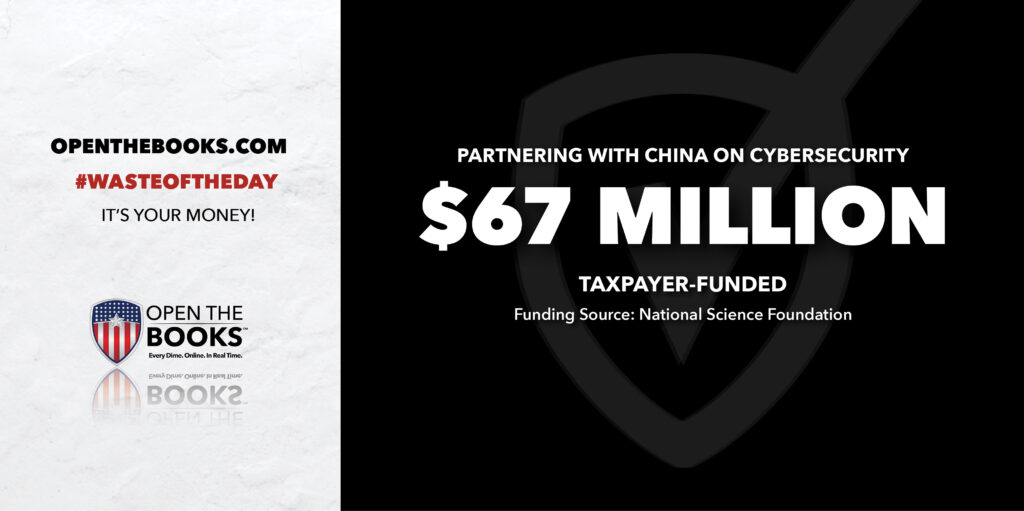
Programmers working on a major cybersecurity project have ties to communist China – the very source of the threat.



Topline: The National Science Foundation is spending $67 million on software that will protect American research from cybercriminals in enemy nations like China. But it’s being built by two universities that accept gifts from China and have faculty members who collaborate with the Chinese military.
The China connection
Key facts: Texas A&M University and the University of Washington are leading the Safeguarding the Entire Community in the U.S. Research Ecosystem (SECURE) program and will receive $50 million and $17 million, respectively.
Rep. John Moolenaar, chair of the House Select Committee on the Strategic Competition Between the United States and Chinese Communist Party, asked NSF Interim Director Brian Stone to pause the program in a March 10 letter. He noted that, unrelated to the SECURE project, the University of Washington “engaged in high-risk research relationships” with Chinese groups listed on the Commerce Department’s Bureau of Industry and Security’s foreign threat watch list.
One University of Washington professor worked on almost 100 studies in collaboration with several of the “Seven Sons of National Defense,” according to data compiled by Moolenaar. Those are Chinese universities that “directly support the country’s defense research and industrial base” and are “prime pathways for harvesting U.S. research and diverting it to military applications,” according to the Hoover Institution at Stanford University.
Moolenaar also cited a 2025 study by researchers at the University of Washington and Hong Kong University that studied artery blockage using Chinese soldiers as subjects.
Several Texas A&M researchers have also collaborated with the Seven Sons on topics like GPS tracking and nanotechnology, according to Moolenaar.
Excuses, excuses
Supporting quote: Texas A&M officials told the Houston Chronicle,
Ultimately, this is a policy decision between Congress and the National Science Foundation. Texas A&M has strong systems in place to protect sensitive research and support national security.
The University of Washington told FOX News that the school
takes research security and integrity very seriously. The UW directs significant effort and resources toward being leaders in research security and integrity, an d goes above and beyond SECURE’s guidance and recommendations. Given the evolving landscape, we are regularly reviewing our guidelines and protocols.
Background: Federal records show that Texas A&M has accepted $15.3 million in gifts and contracts from Chinese sources since 2017. The University of Washington has accepted $7 million. Some of the money was used to fund faculty positions, but the universities did not disclose how most of the funds were used.
More than 250 American universities have accepted almost $5 billion from China dating back to 1987, according to federal records.
Summary: The SECURE program should be led by universities with no potential security issues, especially those as large as China’s.
The #WasteOfTheDay is brought to you by the forensic auditors at OpenTheBooks.com
This article was originally published by RealClearInvestigations and made available via RealClearWire.

Jeremy Portnoy, former reporting intern at Open the Books, is now a full-fledged investigative journalist at that organization. With the death of founder Adam Andrzejewki, he has taken over the Waste of the Day column.





-
 Civilization5 days ago
Election Reform Republicans Can Actually Pass
-

 Civilization5 days ago
Redefining Strategy in the High North: Wargaming a Contested Arctic
-
 Civilization4 days ago
The GOP’s Latino Reset Can Happen Now
-

 Executive4 days ago
Waste of the Day: Feds Bought Golf Carts For $8.4 Million
-

 Executive3 days ago
Waste of the Day: NYC’s $3.5 Million Toilets Are “In Purgatory”
-

 Civilization3 days ago
Does the Donroe Doctrine Now Extend to Outer Space?
-

 Civilization4 days ago
The Kremlin Is Killing the Tool That Sold Its War
-
 Civilization2 days ago
How Prepared Is the Defense Industrial Base for Iranian Cyber Attacks?