
News
California Gov. Newsom proposes $100 million plan for Native American tribes to buy land

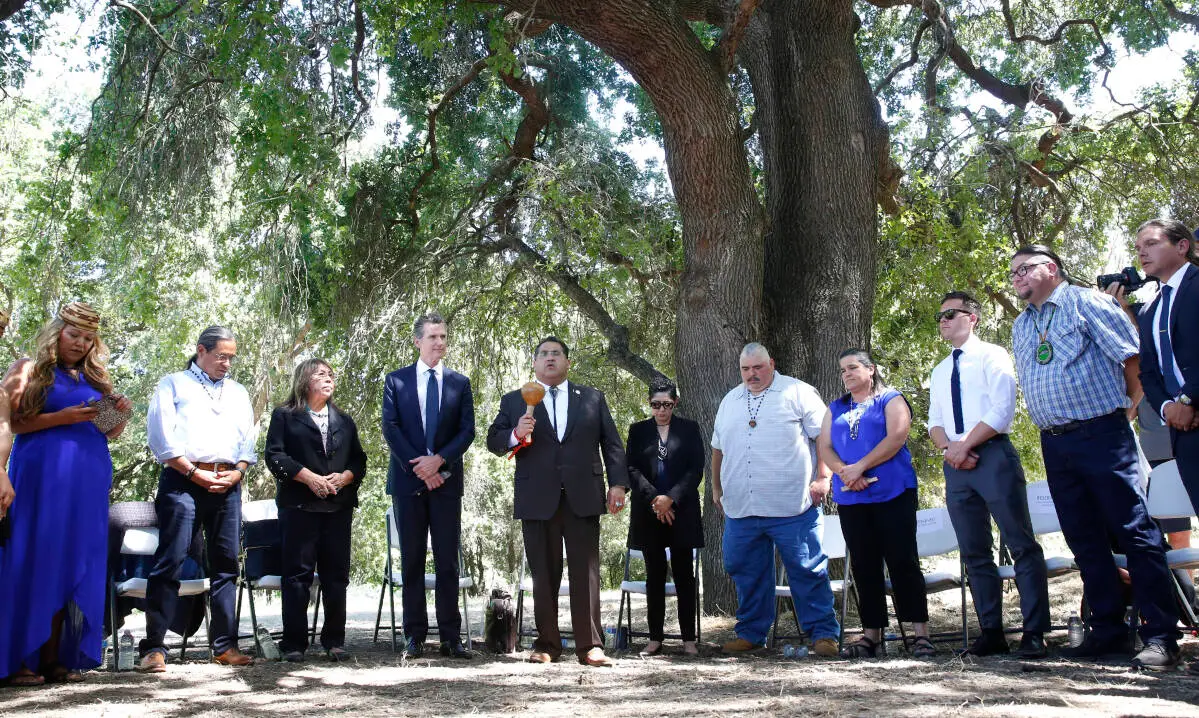
California Gov. Gavin Newsom on Friday proposed giving Native American tribes $100 million to allow them purchase and preserve their ancestral lands.
The proposal is part of his pledge to ensure nearly one-third of California’s land and coastal waters are preserved by 2030. But rather than have the government do all of that, Newsom said tribal leaders should have a say in what lands get preserved.
“We know that California Native peoples have always had an interdependent relation with land, waters, everything that makes up the state of California,” Newsom said. “Unfortunately, we also know that the state has had a role in violently disrupting those relations.”
The money is one piece of Newsom’s $286.4 billion budget proposal. The state Legislature would have to approve the spending before it could happen.
The funding would not function like a traditional state grant program, where the state decides who gets the money and how they can spend it. California Natural Resources Secretary Wade Crowfoot said the administration is “committed to developing a structure or a process where tribes are deciding where these funds are going.”
“There’s so much that we need to learn, obviously, from the tribal communities about how to do this,” Crowfoot said. “We’ve disconnected ourselves from all the tribal ecological knowledge that we need to heal and care for the lands.”
The proposal comes amid a growing Land Back movement to return Native American homelands to the descendants of those who lived there for millennia before European settlers arrived.
Crowfoot spoke during a meeting of the California Truth & Healing Council, established by Newsom in 2019 to “clarify the record” of the “troubled relationship between tribes and the state.”
Tribal leaders were enthusiastic about Newsom’s proposal, but worried how it would work in practice.
Kouslaa Kessler-Mata, a member of the Truth & Healing Council, said the state needed to have a policy in place to resolve those conflicts “so that we don’t just wake up one day and say, ‘Oh, guess what? Right now, that land that you thought was in your ancestral territory is now being acquired by someone else.’”
Caleem Sisk, chief of the Winnemem Wintu Tribe, noted some tribes, like hers are not recognized by the federal government and have few resources of other tribes that are federally recognized. “We’re not in any position to really compete with them for a grant,” she said.
Crowfoot said he did not have a “quick and easy answer” to some of the council’s concerns. He said ultimately the state will need “some sort of consultative body to help us shape this funding to be able to work through that.”

Terry A. Hurlbut has been a student of politics, philosophy, and science for more than 35 years. He is a graduate of Yale College and has served as a physician-level laboratory administrator in a 250-bed community hospital. He also is a serious student of the Bible, is conversant in its two primary original languages, and has followed the creation-science movement closely since 1993.
-
 Civilization4 days ago
Election Reform Republicans Can Actually Pass
-
 Civilization5 days ago
Paul Ehrlich Wasn’t Premature: He Was Wicked
-

 Civilization4 days ago
Redefining Strategy in the High North: Wargaming a Contested Arctic
-

 Civilization5 days ago
The War Over the War
-
 Civilization3 days ago
The GOP’s Latino Reset Can Happen Now
-

 Civilization5 days ago
Joe Kent’s Exit Complicates Things for Trump Administration
-

 Executive3 days ago
Waste of the Day: Feds Bought Golf Carts For $8.4 Million
-

 Executive2 days ago
Waste of the Day: NYC’s $3.5 Million Toilets Are “In Purgatory”