
Legislative
U.S. Congress to reconsider permanent daylight savings time

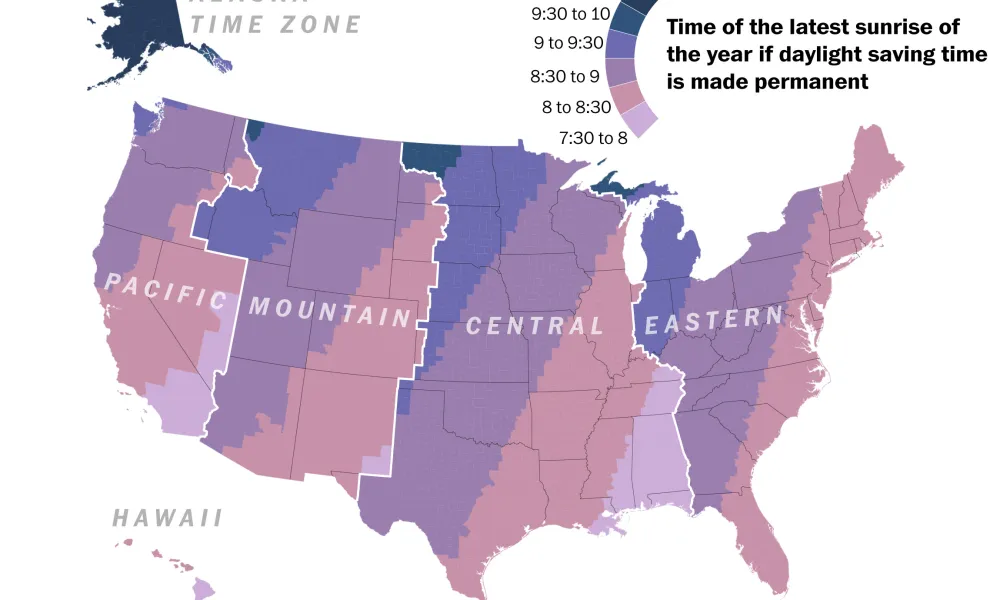
Senator Marco Rubio (R-FL) has returned a piece of legislation to the table that would make daylight saving time permanent nationwide. Rubio said this would bring to an end the “antiquated practice” of changing clocks bi-annually.
“This ritual of changing time twice a year is stupid. Locking the clock has overwhelming bipartisan and popular support. This Congress, I hope that we can finally get this done,” Rubio said in a statement Thursday.
The bill, which is called the Sunshine Protection Act, passed the Senate last year across party lines, no senators opposed it. It has, however, stalled in the House.
If the bill is signed into law, daylight saving time, which begins in March and ends in November, would be permanent across The United States.
American Samoa, the majority of Arizona, Guam, Hawaii, the Northern Mariana Islands, Puerto Rico and the Virgin Islands do not observe daylight savings time and the legislation would not require them to do so.
Several senators, both Republican and Democrats, co-sponsored the original bill, including James Lankford, R-Okla., Ron Wyden, D-Ore., Cindy Hyde-Smith, R-Miss., Rick Scott, R-Fla., Tommy Tuberville, R-Ala., and Ed Markey, D-Mass.
“Alabamians have overwhelmingly expressed their support for the Sunshine Protection Act, and I promised them I’d continue pushing to do away with the outdated practice of adjusting our clocks twice a year,” Tuberville said in a statement shared by Rubio’s office. “It’s time for America to move forward and stop falling back. Congress should listen to the people and make Daylight Saving Time permanent.”
Markey said: “It’s past time for Congress to broaden its horizons and finally make daylight saving time permanent. With the Sunshine Protection Act, we can shine a light on the darkest days of the year and deliver more sun, more smiles, and brighter skies.”
Rep. Vern Buchanan, R-Fla., has introduced companion legislation in the House.
“There are enormous health and economic benefits to making daylight saving time permanent,” Buchanan said in a statement. “Florida lawmakers have already voted to make daylight saving time permanent in my home state and Congress should pass the Sunshine Protection Act to move Florida and the rest of the country to year-round daylight-saving time.”
The United States first adopted daylight saving time in 1918 to save oil and electricity during World War I, however it is no longer associated with saving energy.
A 2011 study found households in Indiana spend an extra $9 million per year in electricity bills because they spent more on heating and cooling, despite people using lights less often.
“The real reason for why this policy came to be and we first started using it was because of energy, and right now it’s a completely open question about whether or not it saves energy,” said Yale Professor Matthew Kotchen, who carried out the research.


Terry A. Hurlbut has been a student of politics, philosophy, and science for more than 35 years. He is a graduate of Yale College and has served as a physician-level laboratory administrator in a 250-bed community hospital. He also is a serious student of the Bible, is conversant in its two primary original languages, and has followed the creation-science movement closely since 1993.