
Executive
Waste of the Day: Throwback Thursday – Studying India’s Politics for a Fee
In 2011, the federal government spent nearly half a million dollars on a grant to study politics in India.


Topline: Congress’ approval rating hit a then-record low of 11% in 2011, but for some reason the U.S. still thought it was qualified to tell foreign politicians how to boost their popularity. The National Science Foundation spent $426,000, or $610,000 in today’s money, for two university professors to follow local politicians around India and study how telling citizens about their government affects politicians’ behavior.
Study politics in India – on a federal grant
That’s according to the “Wastebook” reporting published by the late U.S. Senator Dr. Tom Coburn. For years, these reports shined a white-hot spotlight on federal frauds and taxpayer abuses.
Coburn, the legendary U.S. Senator from Oklahoma, earned the nickname “Dr. No” by stopping thousands of pork-barrel projects using the Senate rules. Projects that he couldn’t stop, Coburn included in his oversight reports.
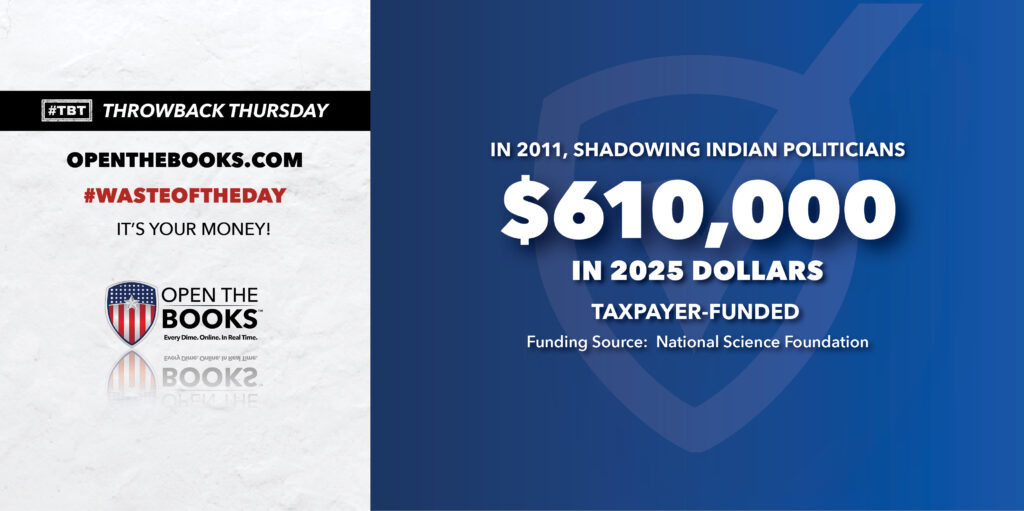
Coburn’s Wastebook 2011 included 100 examples of outrageous spending worth nearly $7 billion, including the cash to study Indian politics.
Key facts: Economists Rohini Pande and Abhijit Banerjee, who today are professors at Yale University and Massachusetts Institute of Technology, respectively, received the grant funds for their work in Delhi.
The economists visited low-income neighborhoods of India in 2010 and informed local politicians that in 2012, a local newspaper would report on their performance over the past two years using data obtained from India’s Freedom of Information Act.
The study concluded that, because the politicians knew their decisions would be publicly disclosed to their constituents, there was a noticeable increase in their “pro-poor spending record.” Even politicians who were not eligible for re-election who increased their pro-poor spending were 29% more likely to win a nomination to run for a different political office.
Why not apply that charity at home?
While the study yielded valuable insight, it’s fair to wonder why the National Science Foundation did not use the grant on studying American politics. The U.S. was gearing up for the 2012 presidential election cycle, and Barack Obama’s approval rating was barely above 40% for most of the year.
At the time, the U.S. was also $40 billion in debt to India, and had given India $126 million in foreign assistance in 2010. That hasn’t changed. In 2024, the U.S. gave India over $165 million in foreign assistance and owed India $234 billion.
Search all federal, state and local salaries and vendor spending with the world’s largest government spending database at OpenTheBooks.com.
Summary: At times it seems like foreign countries should be giving the U.S. advice on government spending, not the other way around.
The #WasteOfTheDay is brought to you by the forensic auditors at OpenTheBooks.com.
This article was originally published by RealClearInvestigations and made available via RealClearWire.

Jeremy Portnoy, former reporting intern at Open the Books, is now a full-fledged investigative journalist at that organization. With the death of founder Adam Andrzejewki, he has taken over the Waste of the Day column.





-

 Civilization5 days ago
The conversation women are having
-

 Executive5 days ago
Waste of the Day: NYC Thermostat Repairers Made $325K, Thanks to OT
-
 Civilization3 days ago
Winning in Iran Requires More Than Military Success
-

 Civilization3 days ago
Epic Fury as It Is: A Look Inside
-

 Civilization4 days ago
America Needs to Understand Golden Dome Before It’s Too Late
-

 Guest Columns3 days ago
Waste of the Day: $34 Billion In Secretive Military Funding
-

 Civilization4 days ago
Becca Rothfeld’s Fanciful Demands of Liberalism
-

 Education2 days ago
Waste of the Day: School Officials Claim Safari Was “Professional Development”