
Guest Columns
Why We Need Lent
As Lent begins, we remember the temptation of Christ in the desert, and the Passion that it presaged, for our sakes.


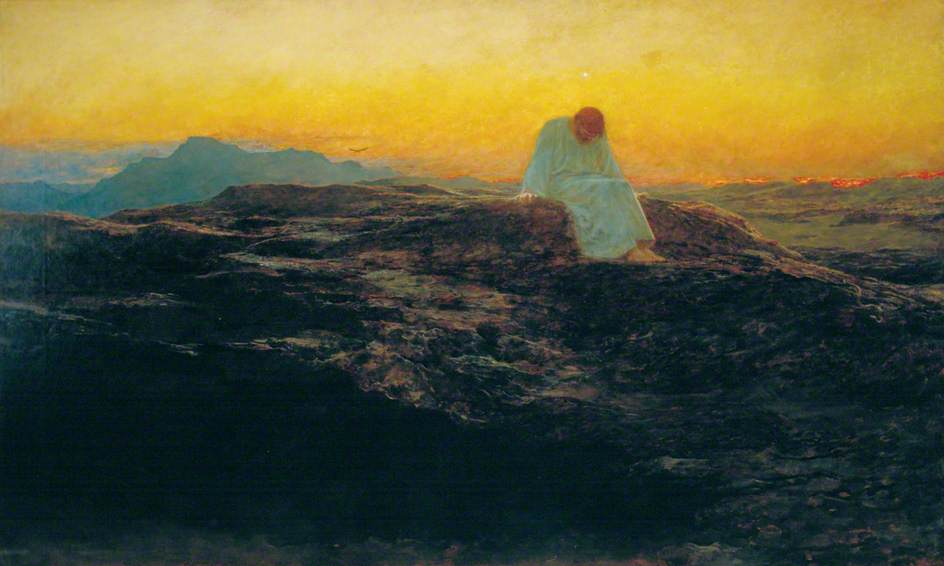
The Temptation of Christ in the Wilderness (1898) by Briton Rivière, a British-born artist, prominently hangs above my home office desk. I bought the print after encountering it in a daily Lenten devotional, Born of Fire, written by Father Innocent Montgomery, CFR, and published by the Knights of Columbus.
What Lent is all about
To me, the scene elicits conflicting emotions: guilt and loneliness, but gratitude and joy. More importantly, the work captures the heart of Lent: rediscovering our true identity.
After his baptism by John the Baptist, Jesus Christ was “full of the Holy Spirit, returned from the Jordan, and was led by the Spirit for forty days in the wilderness tempted by the devil.” In the painting, Rivière depicts Christ — clad in white, symbolizing his holiness and baptism — hunched over, seemingly crushed by the weight of his mission and our sins. The wilderness foreshadows the Passion to be endured on Calvary; in a real sense, the Via Dolorosa begins here.
The setting evokes such themes. The uneven, rocky terrain lies beneath a blazing wildfire sky — perhaps dawn’s breaking. No tree or water exists in the barren landscape. Few signs of life appear aside from a bird gliding on the horizon, a nearly camouflaged snake slithering, and a fox — clothed in shadow — scurrying away.
The impressionistic scene personifies sin’s lifeless and deadening effects. It stands in stark contrast to the abundance Adam and Eve enjoyed — and cast away by succumbing to temptation — in the Garden of Eden.
The beginning of Christ’s sacrifice
Yet Christ obediently, intentionally, and lovingly entered the desert — and our fallen world — for our salvation. In effect, he was isolated; but not alone. As the Gospels attest, Satan was present, tempting him thrice: “to sensual pleasure, to power, and to pride,” which represent “three fundamental ways that all of us can be distracted from the path that God wants us to walk,” as Bishop Robert Barron preaches.
Even so, Christ was not passive in the wilderness, as his posture may suggest in Rivière’s painting. Rather, he was engaged in battle — quietly resisting, persevering, and, indeed, vanquishing the Devil.
Satan, then, sought for Christ to forgo and forget his true identity: as God’s “beloved Son.” In the end, he lost. But not with us — at least not yet. Whether we admit it or not, throughout our daily lives, a similar quiet war is waged in our hearts. And likewise, we are presented with empty promises, which only lead to our ultimate destruction and separation from God, who is love itself.
But war is difficult. And our environment teems with abundance. Endless options and content, however, cannot quench our insatiable senses and pleasures. Through pride, distraction, spiritual malaise, and even nihilism, the Devil employs every tactic to ensnare us. Yet when we forgo God, we forget ourselves — we who, at our baptism, were anointed priest, prophet, and king.
Christ’s invitation
Conversely, the desert is unappealing — at least with a cursory glance at Rivière’s depiction. No one willingly longs to endure pain or confront the darkness lurking within our souls; or even live without our daily comforts. After all, Jesus “ate nothing” for forty days; how could fallible mortals survive the ordeal?
Yet, even in this state, hunched over with eyes hidden, Jesus invites us into the desert — simply to sit by his side. By doing so, accompanied by small sacrifices offered for God’s glory, we are led “to a renewal of our identity as sons [and daughters] of God, our baptismal identity,” as Father Montgomery writes in Born of Fire. This Lenten retreat is imperative, as he adds:
“…we need the desert. We need to leave the world of comfort and self-centeredness and to follow Jesus to the place where we have to let go of everything. Once we let go of ourselves and die to our former selves, then we can receive new life…”
But Lent can feel overwhelming. Exploring our weaknesses, guilts, and sins can be crushing. Often, Satan’s lies try to convince us of our loneliness: that we are abandoned; deserted; and that all hope is lost. In these times, as Rivière’s painting reminds us, Christ dueled with the Devil for us; and his journey did not end with death on Good Friday, but his glorious Resurrection on Easter Sunday.
Indeed, modernity exists in the era of the Empty Tomb. This truth should reassure and sustain us amidst our own trials. As such, we need not be afraid, for “[w]ith Christ and for Christ, victory is certain,” as St. Bernard of Clairvaux once said.
Lent begins with listening
But to begin this Lenten journey, we must first listen — and find reprieve in the silence thereby entering into a relationship with God. As Pope Leo XIV advised in his Message for Lent 2026, listening and fasting “opens paths towards liberation, making us ready and eager to contribute to building a civilization of love.”
Ultimately, the head of this civilization of love spent 40 days in the desert. And as Rivière’s painting shows, with Christ clutching the terrain with pained fingers, dueling against the Evil Doer, he truly prayed about — and fought for — you and me. Why? For love.
As I look up at the scene, the emotional journey ends with a grateful and joyous heart. Christ — my friend — endured torment, suffering, and later death for my sake. He longs for my mind, heart, and soul — and in the desert, I can offer those gifts back to him.
This truth — and love — belongs to you too, dear reader. This Lent, let us recommit to prayer, fasting, and almsgiving; and let us sit side-by-side with he who loved us first, joyfully joining him in renewing and rediscovering our true selves.
This article was originally published by RealClearReligion and made available via RealClearWire.

Andrew Fowler is the Communications Specialist at Yankee Institute and editor of RealClear Religion. He also is the author of "The Condemned," a novella about a Catholic priest fighting off the cartel to save the residents of a small desert town.









-
 Civilization4 days ago
How Prepared Is the Defense Industrial Base for Iranian Cyber Attacks?
-
 Civilization5 days ago
Does the Donroe Doctrine Now Extend to Outer Space?
-
 Civilization2 days ago
Stealth, Sensors, and Staying Power: What the F-35 Just Proved—and What Comes Next
-
 Civilization5 days ago
Imminent Threat? Iran Was Existential Threat
-
 Civilization4 days ago
No Retreat, No Surrender: Why America Must Prevail in Iran
-

 Executive2 days ago
Citizen Sleuths Spotlight Red Flags Galore in Government Spending
-

 Guest Columns3 days ago
Oklahoma’s Digital Future Will Be Built on Affordable, Reliable, Clean Energy Security
-
 Education4 days ago
Waste of the Day: AZ School Vouchers Used For Hot Tub, Wedding Gifts, More