
Education
Waste of the Day: Throwback Thursday – The Story of Robosquirrel
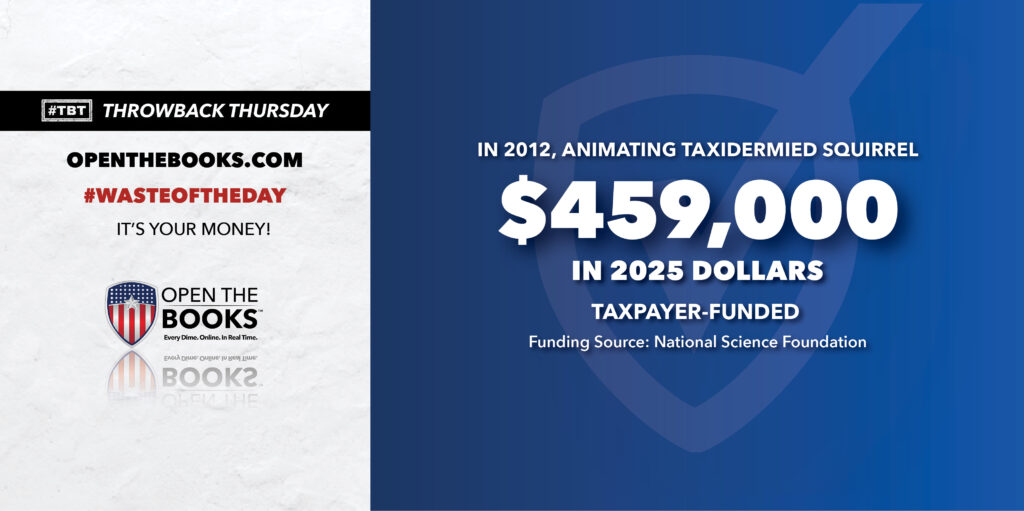
Robosquirrel – a stuffed squirrel with a robotic tail – came about from a $325,000 federal grant to two California universities in 2012.



Topline: Dr. Frankenstein was able to bring his monster back to life using just rusty tools and a cramped workshop. Researchers in California needed taxpayer funding from the National Science Foundation for their own reanimation experiment, with results that were not quite as impressive. In 2012, San Diego State University and the University of California, Davis used part of a $325,000 grant to create “Robosquirrel,” a taxidermied squirrel with a robotic tail. The money would be worth $459,000 today.
How Robosquirrel got its funding
That’s according to the “Wastebook” reporting published by the late U.S. Senator Dr. Tom Coburn. For years, these reports shined a white-hot spotlight on federal frauds and taxpayer abuses.
Coburn, the legendary U.S. Senator from Oklahoma, earned the nickname “Dr. No” by stopping thousands of pork-barrel projects using the Senate rules. Projects that he couldn’t stop, Coburn included in his oversight reports.
Coburn’s Wastebook 2012 included 100 examples of outrageous spending worth more than $18 billion, including the origin story of Robosquirrel.
Key facts: Robosquirrel was built to study the predator and prey relationship between squirrels and rattlesnakes.
The researchers placed Robosquirrel in a cage with live squirrels so that it would smell like the real thing. Then, they placed the robot in a field with snakes and moved it along a track to make it appear alive.
The snakes were fooled. One even bit the robot’s head. But when researchers heated up Robosquirrel’s mechanical tail or made it wag, the rattlesnakes got scared and slithered away.
The project was still in its early stages in 2012. The researchers promised that more animals — including RoboKangarooRat and Robosquirrel 2.0, which could throw rocks at rattlesnakes — would soon arrive, though it’s unclear if they ever materialized.
A national headline
Robosquirrel made national headlines in Forbes, CNN and more after Coburn included it in his Wastebook. San Diego State University told ABC News that only part of the $325,000 grant was spent on taxidermy. The rest went to undergraduate research training.
Search all federal, state and local salaries and vendor spending with the world’s largest government spending database at OpenTheBooks.com.
Critical quote: Sen. Mitch McConnell made Robosquirrel a centerpiece of a long speech criticizing deficit spending on the Senate floor in 2012:
Taxpayers also just spent $325,000 on a robotic squirrel named Robo-Squirrel. Don’t you think [the President] could put together a list of spending cuts that would at least include Robo Squirrel? That is why we have trillion-dollar deficits. … When it comes to deficit deals, the taxpayers need to trust but verify. On cuts, that means specifics.
Summary: If science has advanced to the point of creating robotic animals, avoiding wasteful spending should be a simple task by comparison.
The #WasteOfTheDay is brought to you by the forensic auditors at OpenTheBooks.com.
This article was originally published by RealClearInvestigations and made available via RealClearWire.

Jeremy Portnoy, former reporting intern at Open the Books, is now a full-fledged investigative journalist at that organization. With the death of founder Adam Andrzejewki, he has taken over the Waste of the Day column.








-

 Civilization4 days ago
Stealth, Sensors, and Staying Power: What the F-35 Just Proved—and What Comes Next
-

 Executive4 days ago
Citizen Sleuths Spotlight Red Flags Galore in Government Spending
-

 Civilization3 days ago
Dems Scramble After California Governor’s Debate Implodes
-
 Executive4 days ago
A Consent Decree for Freedom of Speech
-

 Civilization4 days ago
Waste of the Day: Cybersecurity Programmers Have Foreign Ties
-
 Executive3 days ago
America’s $130 Trillion Blind Spot
-

 Civilization2 days ago
Iran Could Reshape the Middle East and the Global Balance of Power
-

 Civilization2 days ago
The conversation women are having