
Executive
Waste of the Day: Fiscal Doomsday Reached With $193.6T Gap
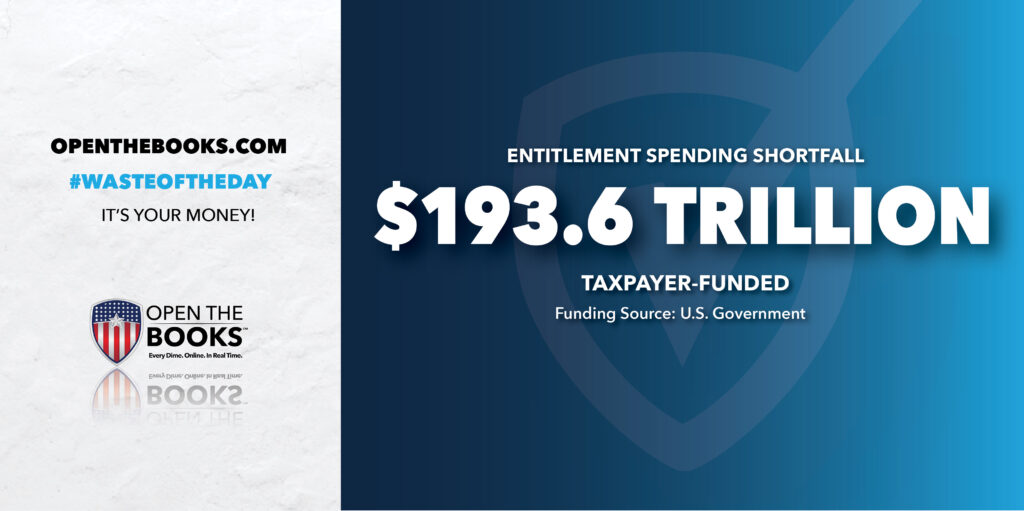
Social Security and Medicare will require $193.6 trillion, even after collection of all payroll taxes, or it will run dry in 2033.



Topline: $193.6 trillion is the most important number in the United States. That’s how much extra money will be needed to fund Social Security and Medicare indefinitely, even after all payroll taxes and premiums are collected.
When Social Security and Medicare will run out of funds
The Fiscal Year 2025 Financial Report of the United States Government, released on March 19, declared that “the current fiscal path is unsustainable,” and the government will be forced to cut benefits by 2033.
Key facts: The Treasury’s financial report has sounded the alarm on safety net programs for years, but the estimates are now more dire than ever. Medicare Part B — which funds doctors’ visits, vaccines, equipment like wheelchairs, and more — makes up most of the funding gap.
It can be difficult to comprehend just how much money $193.6 trillion really is. Every government expense in history since 1787 has added up to $132 trillion. The net worth of every billionaire on the planet combined is $20.1 trillion.
The Treasury says there are only three ways to close the funding gap: borrow money, raise taxes, or cut benefits. To make the budget sustainable within 75 years, America would need to immediately cut non-interest spending by 21%, raise all taxes by 25%, or some combination, according to the Treasury.
Under current policy, that will not happen. America has borrowed money to fund its budget deficits every year since 2001. The country is expected to borrow almost $2 trillion this year to help fund Social Security, Medicare, defense and more.
Debt will be double the GDP by 2049
Borrowing increases the debt held by the public, which the Treasury predicts will hit 200% of the nation’s gross domestic product (GDP) by 2049. If that happens, “no amount of future tax increases or spending cuts could avoid the government defaulting on its debt,” according to the Penn Wharton Budget Model. Interest rates and inflation would go through the roof.
Search all federal, state and local salaries and vendor spending with the world’s largest government spending database at OpenTheBooks.com.
Critical quotes: The financial report did not receive much media attention, but several experts issued severe warnings.
The Cato Institute wrote that it would be “delusional” to suggest we can avoid cutting spending on Social Security and Medicare. They suggest raising the retirement age for Social Security and targeting benefits for seniors who need them most.
Former Comptroller General David Walker and Johns Hopkins economic professor Steve Hanke wrote that “Congress has clearly lost control of the nation’s finances. America is facing a fiscal catastrophe. The reckoning, long deferred, is becoming impossible to ignore.”
Summary: Altering or reducing entitlement spending is politically unpopular, but the nation’s finances suggest it will soon be inevitable.
The #WasteOfTheDay is brought to you by the forensic auditors at OpenTheBooks.com.
This article was originally published by RealClearInvestigations and made available via RealClearWire.

Jeremy Portnoy, former reporting intern at Open the Books, is now a full-fledged investigative journalist at that organization. With the death of founder Adam Andrzejewki, he has taken over the Waste of the Day column.






-

 Executive4 days ago
Waste of the Day: Alabama Hired Lawyer for Lawsuits He Caused
-

 Civilization4 days ago
The Unholy Alliance: Moscow and Beijing’s Invisible Shield Over Tehran
-

 Executive5 days ago
Waste of the Day: Throwback Thursday – Crash Landing for NASA Video Game
-

 Civilization5 days ago
Reclaiming the Lunar High Ground
-

 Civilization4 days ago
President Should Follow His Instincts, Not the Energy Markets
-

 Civilization4 days ago
Stimulating Creativity in Human-Machine Teams
-

 Education3 days ago
Everything’s Bigger in Texas, Including School Debt
-

 Education3 days ago
Restoring Duty to God and Country