
Executive
Waste of the Day: Iraq Training Money Squandered
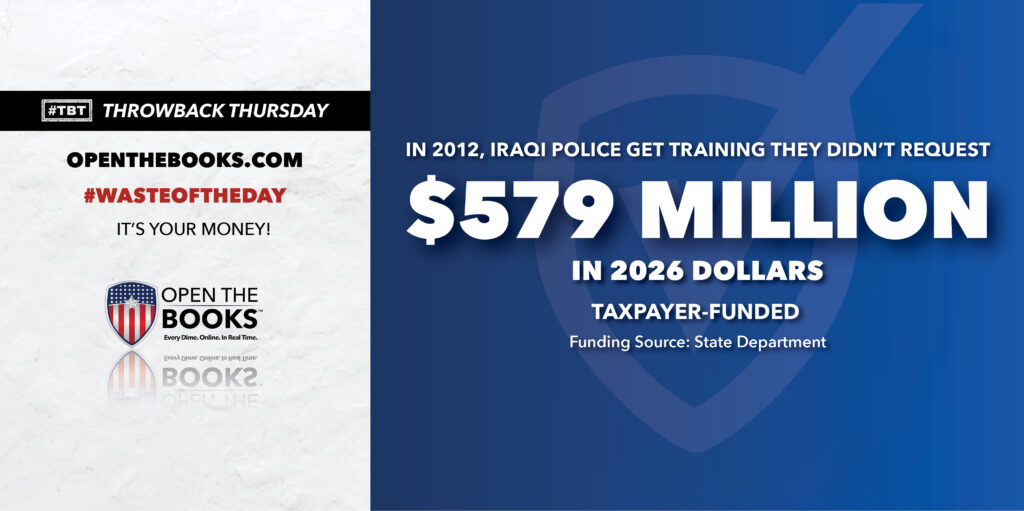
A multimillion-dollar program to provide training for new police officers in Iraq squandred 88 percent of the funds.



Topline: The State Department meant well when it sent police experts to Iraq in 2012 to help train local law enforcement. But Iraq was not exactly a safe place for Americans at the time, and the absurd security costs made the whole venture seem completely pointless.
Iraq spent one-eighth of the funds on actual training
Only 12% of the Police Development Program’s $400 million budget was spent on actual police classes. The remaining 88% was mostly spent on security guards and transportation for the 115 American teachers.
The program cost $579 million in today’s money.
That’s according to the “Wastebook” reporting published by the late U.S. Senator Dr. Tom Coburn. For years, these reports shined a white-hot spotlight on federal frauds and taxpayer abuses.
Coburn, the legendary U.S. Senator from Oklahoma, earned the nickname “Dr. No” by stopping thousands of pork-barrel projects using the Senate rules. Projects that he couldn’t stop, Coburn included in his oversight reports.
Coburn’s Wastebook 2012 included 100 examples of outrageous spending worth more than $18 billion, including Iraq’s poorly budgeted police training.
Key facts: The State Department’s inspector general reported in 2012 that the police program was a “bottomless pit” of taxpayer money. It was “largely unstructured and undefined,” with no specific goals or performance measurements.
The training classes focused on finance, technology and administration, but Iraqi police told the inspector general they did not need help with those topics. Few police officers attended the classes consistently.
The Iraqi government never formally agreed to the program, and they did not provide any funding.
The program was first proposed in 2009, when it was expected to have three times as many teachers at less than half the cost. Logistics made that impossible.
No tangible benefit
Search all federal, state and local salaries and vendor spending with the world’s largest government spending database at OpenTheBooks.com.
Critical quote: Adnan al-Asadi, a senior deputy minister overseeing Iraqi police forces at the Iraqi Interior Ministry, asked the inspector general, “What tangible benefit will Iraqis see from this police training program?” He said the U.S. should “take the program money and the overhead money and use it for something that can benefit the people of the United States.”
Summary: As Congress continues to debate how much to spend on foreign aid, it’s worth remembering that not all aid is created equal.
The #WasteOfTheDay is brought to you by the forensic auditors at OpenTheBooks.com.
This article was originally published by RealClearInvestigations and made available via RealClearWire.

Jeremy Portnoy, former reporting intern at Open the Books, is now a full-fledged investigative journalist at that organization. With the death of founder Adam Andrzejewki, he has taken over the Waste of the Day column.