Civilization
Burned on My 16th Birthday
A young survivor of the Palisades Fire condemns one-party rule, which he blames for the failure that led to the loss of his family home.

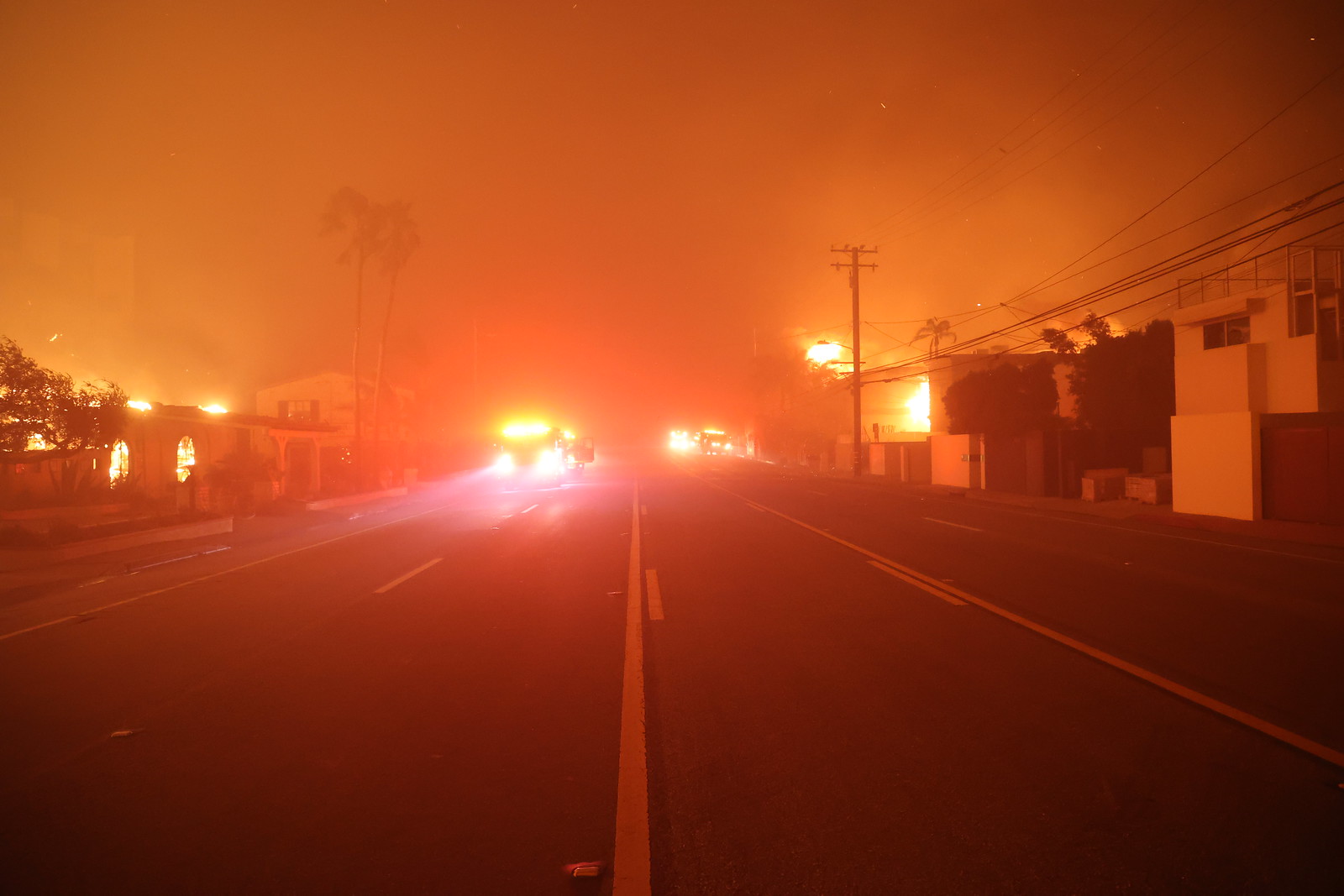
The night I turned 16, my birthday cake had the biggest candle of all time: my own house. Yes, the Palisades fire was approaching my house, which then burned down.
The Palisades is no more
I grew up in Pacific Palisades in northeast Los Angeles – a community whose name is derived from a synonym for “fortress.” So the idea that my house could burn down never crossed my mind. And the notion that our entire community could disappear overnight was absurd.
That’s not to say I wasn’t environmentally conscious. I spent my youth hiking through brush and bramble in the unique Mediterranean climate of the Santa Monica Mountains, camping in Yosemite, Grand Canyon, and Zion. And I volunteered with Resilient Palisades, a nonprofit that lived the “think global, act local” maxim that I fervently believed. I feel like I always understood that our natural environment was irreplaceable. It belonged to all of us, and each and every one of us was responsible for it.
Ever since I was old enough to understand politics, I knew I was a democratic socialist. As a high-spirited teenage optimist, I believed in a system that protects its citizens economically and socially, and trusted in our institutions at every level; they would fulfill the great American promise of good governance. But when I turned 16, I learned I was dead wrong.
Incompetence on many levels of governance
Our family receives the New York Times every day, and my dad makes sure to put it on the kitchen counter. So I couldn’t help but be aware of the routine showboating by supposed federal representatives of the people, or the fact that no one was focused on the issues I cared about. But like most Americans, I was blissfully unaware that this incompetence trickled down to the state and municipal level as well.
My family’s house burned down the morning of Jan. 8, 2025, a full day after the initial blaze came roaring down the hill. It was built with materials designed to resist hours of direct exposure to flame and had state-of-the-art sprinkler systems.
But no family can maintain a municipal water system, coordinate a citywide emergency response, or ensure that firefighters are positioned where they’re most needed. The destruction of my home and Pacific Palisades was not the result of one arsonist or high winds. It was the result of cascading levels of governmental failure. For me, it was the end of my blind faith in government.
The slow-motion crash of response to the Palisades Fire
In retrospect, government failure in the Palisades Fire was a slow-motion car crash. Months before the Jan. 1, 2025, Lachman Fire, Los Angeles Department of Water and Power drained the Santa Ynez Reservoir without a backup plan to ensure adequate water pressure for Palisades hydrants. And then, while the Lachman Fire hadn’t been fully extinguished, fire crews were told to stand down by a still-unnamed LAFD battalion chief.
The incompetence kept building. When the wind picked up on Jan. 7, the hills caught fire again. Fire Station 23 was five minutes away, and if they’d prepared a response to some of the most fire-prone weather conditions L.A. had ever seen, that would’ve been the end of the story. Yet, they were away at the beach doing a “training exercise,” delaying the response by almost half an hour.
As the blaze grew, the situation only worsened. With Mayor Karen Bass on a junket to Ghana, acting mayor Marqueece Harris-Dawson was unaware he could declare a class-one emergency, which would have meant more engines and a police presence to guide evacuees to safety. It was only once my town had been leveled that the governor’s office declared a state of emergency to unlock aid and funding.
Letting it burn
After a chaotic evacuation, with hundreds of crews in position – even with no water pressure on Jan. 7 – they could have saved hundreds of homes using water from swimming pools. Instead, another LAFD official (perhaps the same one who told crews to leave the Lachman Fire site) ordered all ladder and hose companies to stand down. And they were still standing down on the morning of Jan. 8 when water pressure was restored, and there was still time to save my home and neighborhood. Yet, they let it all burn.
We don’t have answers on why any of these decisions were made. Fire Chief Kristin Crowley refused to provide an after-action report on the fire response. The city government is refusing to answer public records requests regarding internal communications on Jan. 7 and 8. Instead, our political leaders have attempted to shift attention and blame to one man: an Uber driver and alleged arsonist who may have started the Lachman Fire. They’re apparently hoping that furor over their many failures will die down. I’m determined to make sure it won’t.
That’s why I created BURNED, a podcast dedicated to investigating the government failure that led to the destruction of my community. It’s more than a story about a fire. It’s a conversation with Los Angeles about what the government owes its people, what happens when it fails to meet that obligation, and what we must demand from it going forward.
The weakness of one-party rule
With my eyes now wide open, I can share a few immediate conclusions. Long-term one-party political dominance in Los Angeles has produced institutional complacency, bureaucratic dysfunction, and a culture of no accountability. Sadly, thanks to increasing partisanship and political division, one-party rule is becoming the norm in more cities and states. In 2021, Texas, a state as dominated by Republicans as California is by Democrats, was hit by a disastrous winter storm they were woefully unprepared for. Despite serious winter-weather failures in 2011 and 2014, Texas Republicans opted to deregulate utilities and power grids. These failures of one-party rule signify the loss of the principal benefits of representative democracy, reasoned debate, compromise, and accountability.
Another conclusion – and a counterintuitive one from a 17-year-old who’s lost his faith in government – is that we need more government, not less. With climate change and AI increasing the risk of disasters that will affect millions, we’re going to need institutions with the resources, information, representation, and oversight necessary to prepare and respond.
Democratic Socialism represents a logical response to these needs. In blue states and cities, DSA candidates are challenging the state Democratic machine, which will increase accountability for the winners. And red states and cities will see the limits of small government in an age of unprecedented risk.
One-party no more?
I loved my home and my town. The loss of both has fueled my commitment to a progressive movement that aims to relegate one-party rule and small government to the dustbin of history. Because institutional failure is not inevitable. Demanding better from our leaders is not just our civic duty. It itself is an act of love for a city plagued by mismanagement.
This article was originally published by RealClearPolitics and made available via RealClearWire.
Editor’s Disclaimer
The author makes a good case against the disastrous response of the City of Los Angeles. But to put it down to mere negligence is as serious an error as any “error” Los Angeles made. To regard Republicans and Democrats as morally equivalent is to assume without warrant that neither party has inherent bad will. The party that put a demented man in the White House through the use of spurious mail-in ballots (and possibly through unauthorized mid-election signals to electronic scanner-tabulators and/or Ballot Marking Devices) is the same party that let the Palisades burn. And what the author totally misses is that this “letting it burn” was deliberate and calculated. That’s something of which no one can accuse the Electrical Reliability Council of Texas, no matter what their failures.
Hal Craig is a high school senior at Harvard-Westlake in Los Angeles. He lives with his family in Encino, California.