
Civilization
General Misconduct: There Is an ‘I’ in Milley
General Mark Milley seems more interested in protecting his ego than in actually doing his job, as his many public statements show.


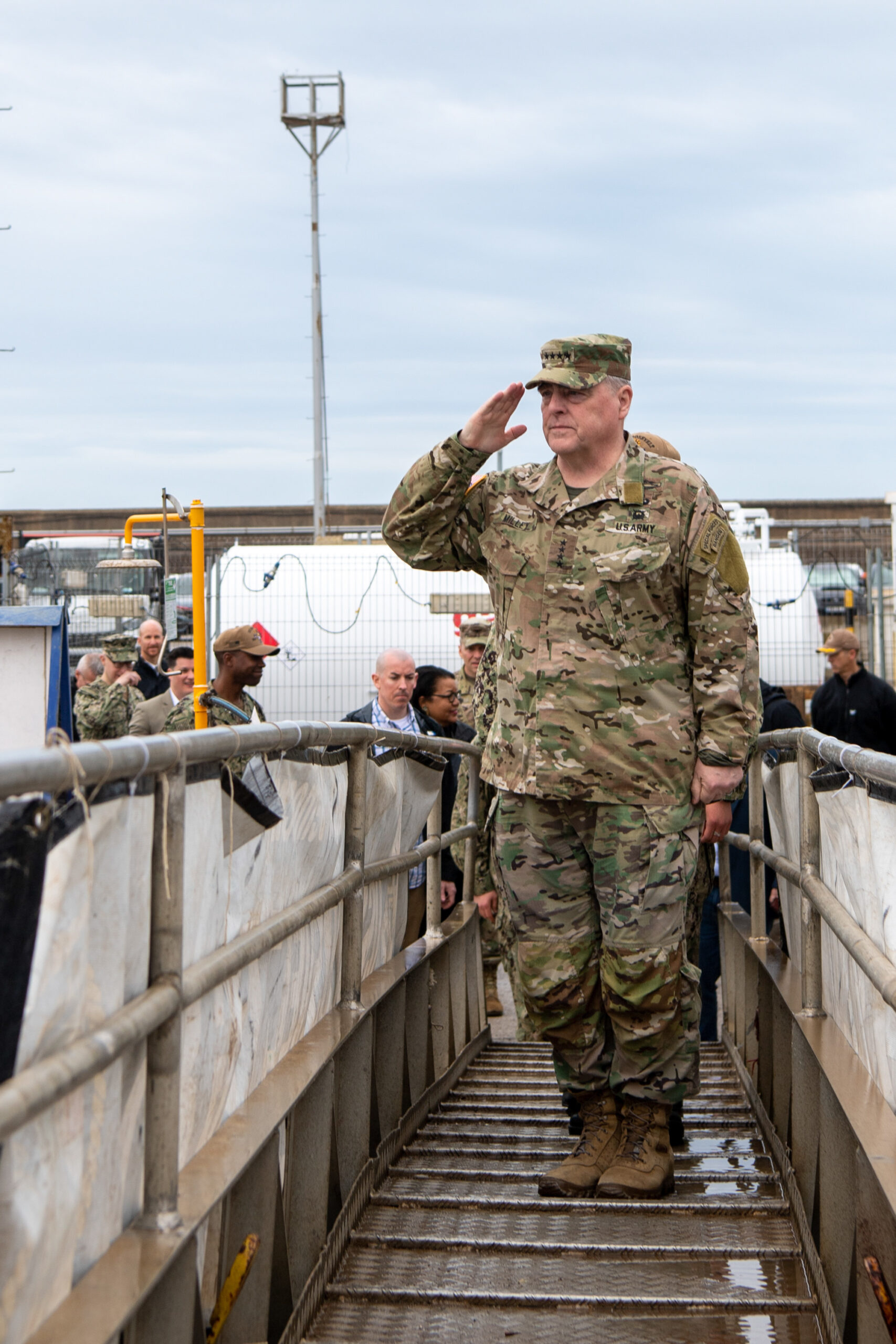
The soul of America is at stake amidst political gamesmanship. As concerning – the soul of the military continues to be a battleground. An arena that consists of an enemy more potent than China or Russia; instead, the egos of General’s and former senior officers threaten to undermine national security. But Generals’ answer to political leaders. In fact, even when they become political leaders, former officers can be held responsible for the oath they took while in uniform. General Mark Milley is probably the most prominent architect of subsuming the military’s integrity in the hubris of his own ego. He engaged in direct subterfuge when he called the President a fascist. But worse Milley created a more subtle blueprint of subversion in which an equilibrium of balancing facts and fallacious intentions were anchored in his self-service.
Mark Milley constantly plumping his own image
General Mark Milley’s public quotations sketch a portrait of a commander constantly positioning himself as the Republic’s necessary conscience—ever visible, ever declarative, and ever at the center of the frame. His defenders call it candor and constitutional fidelity. His record of remarks, however, reads like a running performance of moral self-positioning that places “I” at the apex of every crisis. Taken together, the pattern suggests an ego that treats public controversy as a stage and the uniform as a microphone.
Consider his most famous mea culpa. After appearing in the Lafayette Square photo op in June 2020, Milley recorded an unusually personal video address: “I should not have been there,” he said, adding, “My presence in that moment and in that environment created a perception of the military involved in domestic politics.” Those lines were praised for contrition. Yet the form—high-production apology, spotlight on his own judgment—also elevates his role in the narrative. Rather than reinforcing institutional boundaries quietly, he made himself the protagonist of rectitude. He did not simply correct; he performed correction, casting his judgment as the moral hinge on which public trust ought to swivel.
Constant self-staging
He adopted a similar posture in the culture-war hearing that vaulted him into cable-news orbit. In June 2021, pressed about curriculum at West Point, Milley declared,
I want to understand white rage. And I’m white.
then followed with,
I’ve read Mao Zedong. I’ve read Karl Marx. I’ve read Lenin. That doesn’t make me a communist. So what is wrong with understanding … having some situational understanding about the country for which we are here to defend?
On the merits, intellectual curiosity is defensible. On the optics, he again placed himself center stage—casting himself as the enlightened arbiter who both defies accusations and instructs the nation on what it means to be informed. The effect was not to depoliticize the institution but to thrust its most senior officer into a partisan spectacle with himself as a conscientious foil, a posture that flatters the speaker more than protects the force from political crossfire.
Milley’s rhetorical obsession with constitutional fidelity further reveals the same self-staging. “We don’t take an oath to a king or a queen, a tyrant or a dictator. We don’t take an oath to an individual,” he has said in multiple public remarks, often amid the turbulence of domestic politics. The sentence is technically unimpeachable. Yet its repetition comes with a visible subtext: Milley is the sentinel, serenely reminding lesser mortals of the republic’s creed. These statements were designed to be quoted and retweeted; because they were crafted as moral set pieces. At a time when the military’s quiet adherence to civilian control would speak loudest through restraint, Milley chose to speak loudly, framing himself as custodian-in-chief of civic virtue.
On Afghanistan
Even his testimony after the Afghanistan withdrawal bore the stamp of ego-protective positioning. In the September 2021 hearings, Milley told senators, “I recommended that we maintain a steady state of 2,500” troops and warned of “the potential for the Afghan security forces to collapse.” He later characterized the outcome as a “strategic failure.” This is a convenient pattern: attach yourself to the prediction that proved right, disclaim responsibility for the decision that proved wrong, and narrate the entire affair from the vantage point of your personal foresight. The uniform requires collective accountability; the testimony sounded like brand management and the chairman as sage whose advice, had it been heeded, would have produced a better world.
His defense of backchannel reassurances to China similarly leaned on performative absolution. Amid reporting that he called Beijing to avert miscalculation, Milley insisted, “My calls were perfectly in line with my duties,” and, “At no time was I attempting to undermine or usurp the authority of the civilian process. My loyalty is to the United States Constitution.” Again, the words are carefully chosen. Instead of letting documentation and process speak for themselves through established channels, he emphasized his own loyalty and judiciousness, as if fidelity were a personal brand to be asserted publicly rather than an institutional constraint to be maintained quietly. The message was less “this is routine de-escalation” than “trust me personally,” a subtle but telling difference.
Milley tries to offer himself as indispensable
Across these incidents runs a common thread: Milley narrates crises with himself as indispensable interpreter. In the apology, he is the corrective conscience. At the culture hearing, the enlightened explainer. In Afghanistan, the prescient adviser. In China calls, the constitutional loyalist. The consistent center of gravity is not the institution’s integrity but the general’s self-presentation as the institution’s integrity personified. That is ego, not simply leadership—an insistence on being the lens through which the public is asked to see the military’s role.
Defenders will argue that visibility was necessary: the country was riven by distrust, the military needed reassurance, and the chairman’s voice carried weight. But reassurance is not the same as self-dramatization. Reassurance is crisp, bounded, and institution-first. Self-dramatization is expansive, quotable, and “I”-first. Milley’s quotable posture consistently chose the latter, inviting an audience to appreciate his internal compass rather than the armed forces’ external discipline. In a healthier civil-military culture, the chairman would not need to star in a redemption arc, deliver a viral lecture on race, or center his personal advice in the postmortem of a failed war. He would ensure the institution spoke through its results and protocols.
I, I, I
The language itself betrays the habit. “I should not have been there.” “I want to understand white rage.” “I’ve read Mao… Marx… Lenin.” “I recommended that we maintain…” “My calls were… my loyalty is…” There is nothing inherently wrong with the first-person pronoun; accountability requires it. But when the bulk of a leader’s high-profile interventions are self-referential proclamations crafted for public consumption, the impression hardens that the leader’s primary audience is the mirror. The risk is not only that critics see ego; it is that subordinates learn the wrong lesson about command—how to sound righteous on television rather than how to keep their service out of politics and their focus on warfighting readiness.
It is telling that Milley’s defenders so often praise his words rather than his quiet stewardship. If the most memorable artifacts of a tenure are an apologetic video, a culture-war exchange, and artfully righteous testimony, one has practiced the craft of public positioning more than the craft of invisibility that marks the best civil-military judgment. In the American system, generals advise in private, implement in public, and rarely audition for the role of national ethicist. Milley blurred those lines and then narrated the blurring as virtue—always with the invisible implication that he, uniquely, was seeing clearly.
Ego trumps humility
Ego also crowds out humility in the allocation of blame and credit. By foregrounding his recommendation to maintain 2,500 troops, he positioned a safe bet on historical vindication while distancing himself from a strategic outcome he labeled a “failure.” Yet the decades-long drift in Afghanistan was not one week’s policy call; it was the cumulative product of military and civilian choices, including the assumptions senior commanders carried and communicated year after year. A humbler reckoning would have focused less on “my advice” and more on “our errors,” less on showing that he was right and more on explaining how the institution enabled wrong.
Similarly, his dramatic framing of constitutional loyalty during domestic political storms implies that previous generations needed the current chairman to restate the obvious. They did not. The military’s apolitical posture is sustained by thousands of daily decisions: who speaks, who doesn’t, what is emphasized, what is ignored—made far from cameras. In elevating himself as the herald, Milley implicitly downgraded that quiet discipline, as if the country’s confidence hinged more on his public phrasing than on the force’s internal steadiness.
Milley perfects performance art
None of this suggests he is insincere about the Constitution or uninterested in truth. It suggests he is consistently interested in being seen as sincere and truth-seeking, which is not the same thing. In the age of permanent media, the temptation to curate an image of moral ballast is intense, especially for those at the pinnacle of power. The job of a chairman is to resist that temptation, not to master it. Milley mastered it. And mastery of optics is a poor substitute for mastery of civil-military boundaries.
In the end, Milley’s quotations are not merely words; they are mirrors. They reflect a leader who habitually centers himself as the moral actor in every drama and asks the public to measure the military’s trustworthiness by his visible conscience. That is ego wearing the costume of virtue. The United States needs Generals’ who practice constitutional fidelity without theatrics, strategic candor without self-congratulation, and public restraint without self-exoneration. From his own mouth, Milley taught America a different lesson: that the last word of a controversy should belong to the man at its center, because he believes his judgment is the story. The country deserved the institution; it got the performance.
This article was originally published by RealClearDefense and made available via RealClearWire.





-
 Civilization4 days ago
How Prepared Is the Defense Industrial Base for Iranian Cyber Attacks?
-

 Civilization2 days ago
Stealth, Sensors, and Staying Power: What the F-35 Just Proved—and What Comes Next
-

 Executive2 days ago
Citizen Sleuths Spotlight Red Flags Galore in Government Spending
-

 Civilization4 days ago
No Retreat, No Surrender: Why America Must Prevail in Iran
-

 Guest Columns3 days ago
Oklahoma’s Digital Future Will Be Built on Affordable, Reliable, Clean Energy Security
-

 Education5 days ago
Waste of the Day: AZ School Vouchers Used For Hot Tub, Wedding Gifts, More
-

 Executive4 days ago
Waste of the Day: Throwback Thursday – Helping Beverly Hills’ Low-Income Community
-

 Civilization1 day ago
Dems Scramble After California Governor’s Debate Implodes