Civilization
Eisenhower’s D-Day Lesson for America at 250: Make the Problem Bigger
If America at 250 has a problem with people not agreeing on history, Dwight D. Eisenhower would say to make the problem bigger.

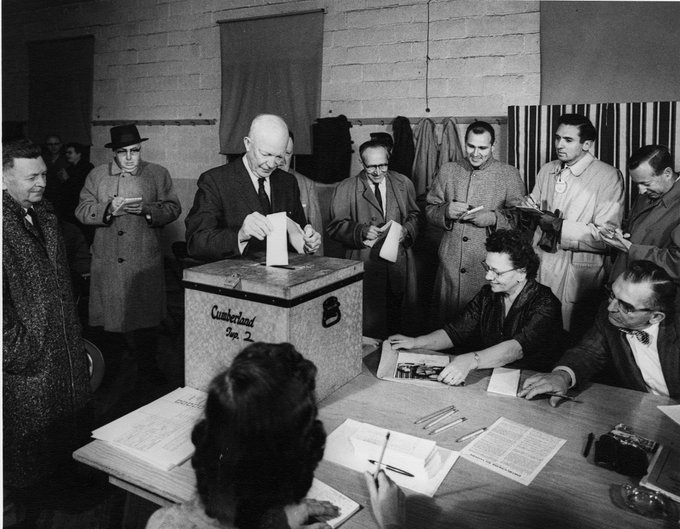
This month, American moviegoers will watch Oscar-winner Brendan Fraser as Gen. Dwight D. Eisenhower in Pressure, alone in a storm-lashed Portsmouth headquarters in June 1944, weighing weather reports, casualty estimates, and the fate of the free world. The film’s power lies in what Eisenhower refuses to do: Narrow the decision, delegate the doubt, or pretend the problem is smaller than it is.
Eisenhower and his Enlargement Principle
Eighty-two years later, as America approaches its 250th birthday, we are doing precisely the opposite.
In Philadelphia this spring, interpretive panels describing the enslaved people who labored in George Washington’s President’s House were quietly removed, then partially restored, then contested again. A few blocks away, a school group’s history tour was canceled after parents on both sides objected to what their children might hear. In Washington, D.C., two federal commissions, each claiming authority over the semiquincentennial, are issuing competing guidance on how the nation should commemorate its 250th birthday.
A republic anchored in the First Amendment cannot agree on how to talk about itself.
The instinct, on every side, is to make the argument smaller: Strip the panel, cancel the tour, narrow the commission, silence the other camp. Eisenhower would have recognized the impulse and rejected it.
Whenever I run into a problem I can’t solve, I always make it bigger. I can never solve it by trying to make it smaller, but if I make it big enough, I can begin to see the outlines of a solution. Dwight D. Eisenhower
Eisenhower’s enlargement principle has never been systematically applied to free expression. It should be. The censor’s reflex – whether it comes from a school board, a federal agency, a university provost, or a social media platform – is always to shrink the frame until only approved speakers remain inside it. Ike saw through this. “Censorship, in my opinion,” he said, “is a stupid and shallow way of approaching the solution to any problem.” He said it as a general who had seen totalitarianism up close, and as a president who understood that a free society’s strength lies in its willingness to argue in public.
America at 250 does not belong to one group only
Enlarging the problem at 250 means refusing the premise that America’s history belongs to one faction. The President’s House is not a battleground between patriotism and honesty; it is the site where both must coexist, because George Washington was both the indispensable founder and a slaveholder, and a serious country can hold both facts in view. A commemoration that erases either one is not a commemoration; it is a press release.
The same logic applies to our commemorative machinery. Competing federal commissions are a symptom, not a scandal. The solution is not to crown a winner but to widen the table: Invite state humanities councils, tribal nations, local historical societies, veterans’ groups, houses of worship, and yes, dissenting scholars, into a commemoration large enough to contain the country it is celebrating.
Utah Gov. Spencer Cox has modeled something like this with his bipartisan “Disagree Better” initiative and his February 2026 America at 250 Forum, which deliberately seated together people who do not normally share a stage. The point is not forced consensus. The point is that disagreement, conducted in good faith and in public, is itself a form of patriotism older than the Republic.
Not the federal government, but the kitchen table
But governors and commissions cannot carry this alone. The durable infrastructure of free expression in America has never been federal. It has been what I call the kitchen table, the informal civics classroom where parents, grandparents, neighbors, coaches, clergy, and teachers transmit the habits of argument to the next generation. Kitchen tables are where children first learn that an uncle can be wrong about politics and still be family, that a neighbor can vote the other way and still be a neighbor, that a hard question deserves a real answer rather than a curated one.
We have spent a generation outsourcing these conversations to platforms engineered to punish nuance and reward contempt. The result is a country that can livestream its disagreements but can no longer sit through them. Rebuilding the kitchen table is not nostalgia. It is civic maintenance. It happens in book clubs and Rotary meetings, in classrooms that still teach civics as a contact sport, in local libraries that host genuinely opposing speakers, in families that treat Thanksgiving as a democratic exercise rather than a landmine.
To follow Eisenhower, invite more voices
For America 250, the question is not whose version of America wins the anniversary. The question is whether we still possess the freedom, and just as importantly, the stamina, to argue about our own country honestly, in public, with people who see it differently.
Pressure ends with a general who refused to make his decision smaller than the moment demanded. At 250, Americans owe their republic the same refusal.
Eisenhower would say, “Make the problem bigger.” Invite more voices in, not fewer. A nation confident enough to argue with itself at 250 will still be arguing at 300.
This article was originally published by RealClearPolitics and made available via RealClearWire.
Stuart N. Brotman is digital media laureate and a distinguished senior fellow at The Media Institute, and the author of Free Expression Under Fire.