
Executive
Waste of the Day: DOD “Wish Lists” Continue
The War (Defense) Department is actually required by law to submit wish lists to Congress, rather than submit a realistic budget.



Topline: President Donald Trump’s $1.5 trillion budget request for the military is by far the largest in U.S. history, but under a law passed during Trump’s first administration, the Pentagon is required to tell Congress it’s too low.
Wish lists required by law since 2017
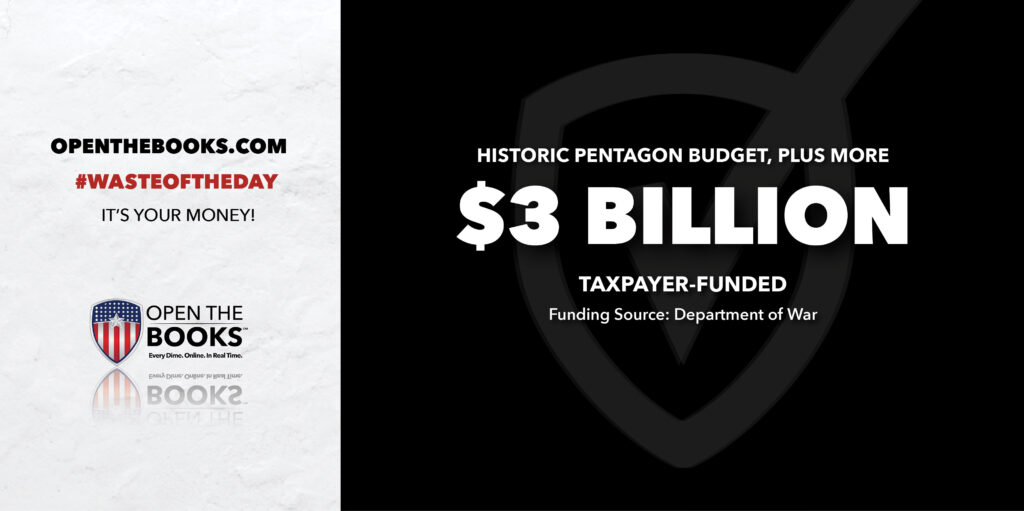
The Army, Navy and Air Force submitted unfunded priority lists totaling $3 billion for fiscal year 2027, according to Breaking Defense. Often referred to as “wish lists,” the reports ask Congress to fund additional items not included in the president’s budget request.
Key facts: The Pentagon began submitting wish lists in the 1990s. In 2017, it became a law that each branch of the military must create one.
Congress typically funds almost every item on the lists, but critics have long highlighted them as a source of fiscal waste. The projects are ones that both the president and the secretary of defense already decided were not worth including in their funding requests. Mike McCord, the Pentagon’s comptroller under President Joe Biden, tried to end the practice.
This year’s lists include only construction projects and are small compared to previous years. Last year’s wish lists totaled more than $50 billion and included weapons, research projects and more.
It does appear there’s a loophole in which the Pentagon doesn’t actually need to include anything on its list.
The Air Force submitted the largest list, with 41 construction projects worth $1.7 billion. But the Marines, Space Force, Africa Command and several other branches submitted empty unfunded priority lists, telling Congress that Trump’s budget request already includes all the resources they need.
Search all federal, state and local salaries and vendor spending with the world’s largest government spending database at OpenTheBooks.com.
Increased military budget
Background: The military budget would increase by 44% next year if Congress passes the president’s budget request without changes.
Even though the request asks Congress to make cuts at other departments, it would still increase the government’s overall discretionary budget by 19%. That would be the second-largest increase on record going back to 1962, aside from 2020, during the Covid-19 pandemic.
The #WasteOfTheDay is brought to you by the forensic auditors at OpenTheBooks.com.
Summary: Santa Claus can afford to be overly generous and deliver every item on a wish list, but a government with limited resources might need to rethink its process.
This article was originally published by RealClearInvestigations and made available via RealClearWire.

Jeremy Portnoy, former reporting intern at Open the Books, is now a full-fledged investigative journalist at that organization. With the death of founder Adam Andrzejewki, he has taken over the Waste of the Day column.







-

 Civilization4 days ago
Texas Needs To Stay Texas on AI
-

 Executive5 days ago
Reflections on the 25th Anniversary of the 9–11 Attacks: Our Collective Failure of Imagination
-

 Civilization3 days ago
Devolution Revolution: Americans Returning Power to the People
-

 Civilization2 days ago
Down the Road, Conservatives Debate GOP’s Future
-
 Civilization4 days ago
GOP Bets on Trumpapalooza To Defy Midterm History
-

 Civilization3 days ago
We Are in World War Xi
-

 Guest Columns2 days ago
Pumpkin Spice and the AI Apocalypse
-

 Civilization1 day ago
AI Can Give Cyber Defenders the Upper Hand