
Executive
Waste of the Day: Studying TV Reruns
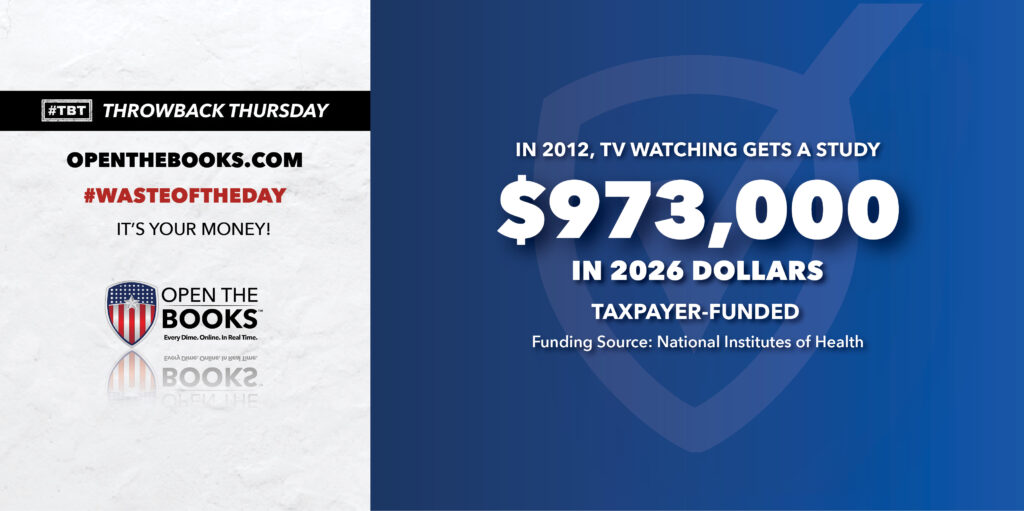
In 2012, the government spent nearly a million present-day dollars studying those who watch a lot of reruns on television.



Topline: Plenty of Americans recharge their energy by curling up with a good book or watching reruns on television. But, in case anyone was unaware, the National Institutes of Health spent taxpayer dollars in 2012 to discover that very fact.
Hundreds of thousands of dollars to find out about television viewing habits?
A federally-funded study concluded that those who had to show “self-control” or “regulate their emotions” during the work day were more likely to seek “greater immersion in a familiar fictional world the next day.”
The project received an undisclosed portion of a $667,000 grant, or $973,000 in today’s money.
That’s according to the “Wastebook” reporting published by the late U.S. Senator Dr. Tom Coburn. For years, these reports shined a white-hot spotlight on federal frauds and taxpayer abuses.
Coburn, the legendary U.S. Senator from Oklahoma, earned the nickname “Dr. No” by stopping thousands of pork-barrel projects using the Senate rules. Projects that he couldn’t stop, Coburn included in his oversight reports.
Coburn’s Wastebook 2012 included 100 examples of outrageous spending worth more than $18 billion, including the funds to examine television.
Key facts: The federal funding was set aside for studies of alcohol abuse and intimate partner violence, though the TV study by a researcher from the University of Buffalo had only a tangential connection to those topics. It argued that, without escapism and fiction, people may be less able to regulate their emotions and engage in destructive behaviors.
Otherwise unfulfilled needs can often be met through social surrogacy: “Interaction” with nonhuman or fictional social targets. When “real” social interaction is unavailable, people meet belongingness needs through parasocial interaction with television characters.
Specific experiments
In one experiment, mentally drained participants were asked to write about their favorite TV show, while another group merely wrote a list of objects in the room with them. All the participants then completed a puzzle task, which showed better scores from those who had written about TV.
In the second study, 86 college students kept a 14-day diary. They reported whether they had to control their thoughts or regulate their mood each day, and whether they later watched a favorite TV rerun or re-read one of their favorite books. The study found students were more likely to turn to a familiar fictional world the day after exerting self-control.
The study did warn that watching TV too often could have “deleterious effects on long-term health” and leave people with “fewer social resources over time.”
Search all federal, state and local salaries and vendor spending with the world’s largest government spending database at OpenTheBooks.com.
Summary: Just like a rerun, the federal government is still funding absurd research studies year after year.
The #WasteOfTheDay is brought to you by the forensic auditors at OpenTheBooks.com.
This article was originally published by RealClearInvestigations and made available via RealClearWire.

Jeremy Portnoy, former reporting intern at Open the Books, is now a full-fledged investigative journalist at that organization. With the death of founder Adam Andrzejewki, he has taken over the Waste of the Day column.