
Civilization
Hilton Channels Lasso, Punches Hard Against Becerra
On the campaign trail with Steve Hilton, running a long-shot race for California governor against Xavier Becerra.


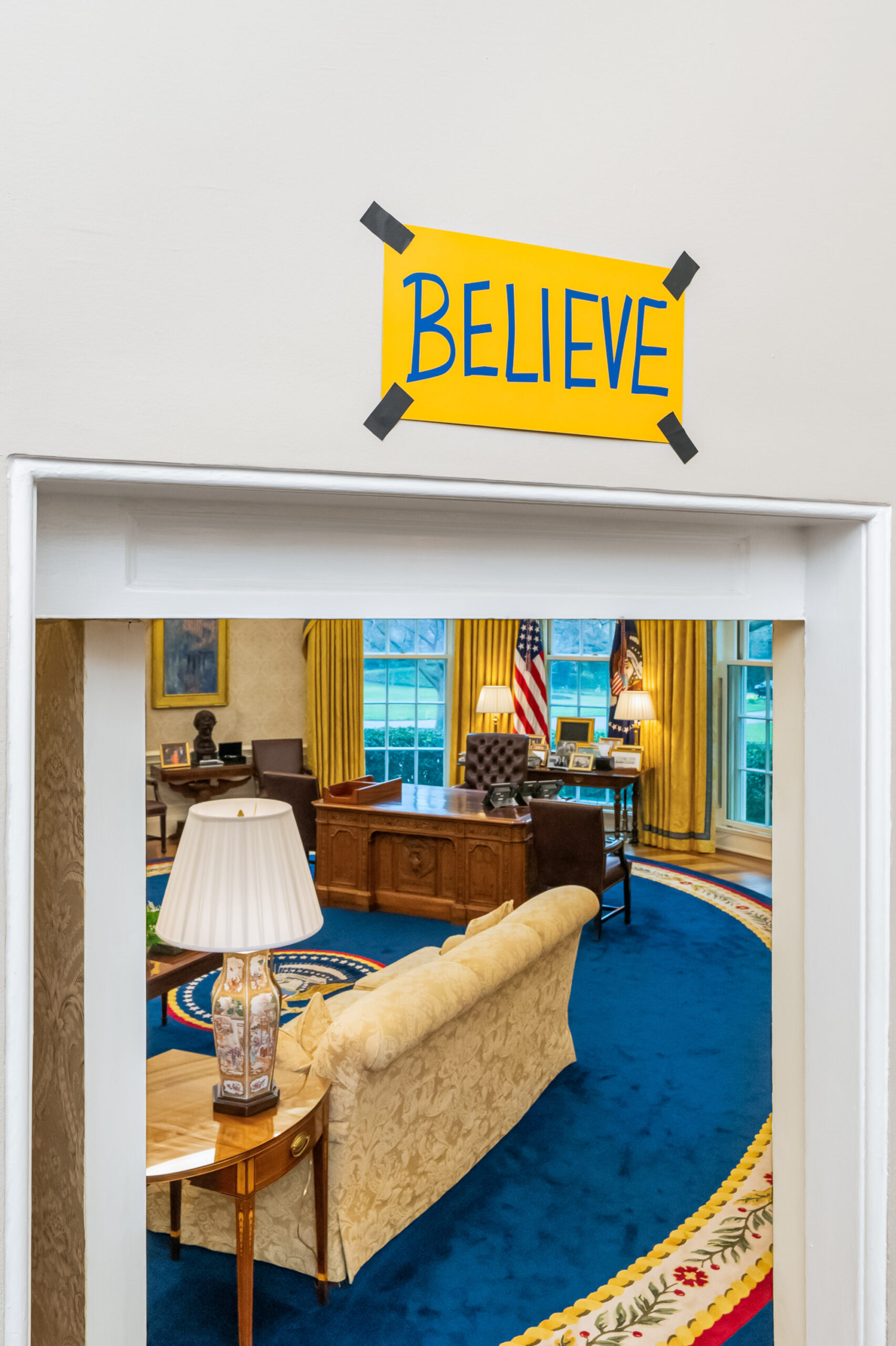
Steve Hilton has a favorite sign. Not a campaign sign – a sign from his old life, bolted to the atrium wall of Stanford University’s Institute of Design, where he taught for a couple of years after moving to the Bay Area from England in 2012. It’s a simple line with a simple goal: The best way to do it is to do it.
Steve Hilton just does it
“It’s kind of true,” the former Fox News host told RealClearPolitics in an interview last week. “You just have to do it – take that first step, take the action.”
It is also a very Ted Lasso type of sentiment – the kind of relentless homespun optimism that made the fictional soccer coach and his hand-painted “BELIEVE” sign a cultural touchstone – even though Hilton himself says he’s never watched the show. He’s too busy crisscrossing the state and rolling out policy proposal after proposal, which he pledges will help California become “golden again.”
Talking about the nuts and bolts of his campaign’s get-out-the-vote operation – organizing volunteers, cutting instructional videos, building “templates” for door-knocking and ballot collection – Hilton kept circling back to the same instinct: Stop worrying about being the underdog and start doing.
“We’ve just got to get better at it than we have been,” he said of California Republicans’ ballot-harvesting efforts and attempts to compete with a Democratic turnout machine that has dominated California elections for two decades.
Ballot-harvesting blitz
It may be the least glamorous but most consequential piece of Hilton’s long-shot bid to outpace his frontrunner opponent, former Health and Human Services Secretary and state Attorney General Xavier Becerra, to become California’s first Republican governor since Arnold Schwarzenegger.
The clock on that project is now running short. Hilton and Becerra meet Sept. 30 for their first one-on-one debate, a nationally televised CNN faceoff scheduled to take place just as county elections officials begin mailing ballots to California’s roughly 23 million registered voters.
Hilton’s favorite illustration of the philosophy in action came from the June primary. A volunteer showed up to one of his campaign events in Lancaster, a high-desert city outside Los Angeles, carrying, as Hilton described it, “armfuls of ballots.”
“What are you doing?” he asked her.
Her answer: she’d thrown a ballot-harvesting pizza party. Invited her friends over, walked them through the process, and left with a stack of completed ballots to turn in. Hilton had someone film her explaining how she did it and turned it into a template his campaign could hand to other volunteers.
It’s a quaint anecdote, but one that captures how Hilton talks about his entire turnout strategy: less a top-down machine, more of rolling referendum to fix California’s myriad problems, which he argues is picking up steam and spreading across the state.
Hilton acknowledges the machine
“You’re completely right that they’ve got this machine,” Hilton said, acknowledging what he’s up against. “There’s no question that that’s going to be springing into action. But we can’t just give up. We just have to build our own machine, and that’s what we’re trying to do here.”
He’s not doing it alone. Hilton pointed to his partnership with Carl DeMaio, a GOP assemblyman from San Diego County and longtime conservative activist who runs Reform California, on mailing out voter guides and organizing ballot collection “in an organized way.”
Hilton’s pitch to fellow Republicans, who have historically been squeamish about the practice, is pragmatic and blunt: Democrats built the state’s permissive ballot-harvesting rules to their own advantage, so Republicans should stop complaining and start using them too.
He also asserted that this cycle has brought a level of investment in Republican turnout operations in California that he says hasn’t been seen “in a long time” – running, he said, in parallel with his own campaign.
Campaign spokesman Hector Barajas tells RCP that the ballot-harvesting operation involves a “faith-based operation and a statewide program with county and local chairs.”
“We understand the system and the rules, and Steve’s campaign will include it as part of his campaign strategy,” Barajas adds.
Hilton running against ‘the machine’
Hilton has already put that framing on screen. In July, his campaign released “The People vs. The Machine,” an AI-generated ad produced by Charles Curran, the filmmaker behind the viral videos that powered Spencer Pratt’s bid for Los Angeles mayor.
The spot opens with a hulking, post-apocalyptic robot the narrator calls “the machine,” which Hilton, rendered in AI animation, is shown battling head-on.
“As long as the machine leads California, nothing will ever change,” the ad’s narrator intones, before the campaign followed up days later with a gladiator-themed sequel casting ordinary Californians as combatants forced to fight the same mechanical monster.
“This ad is showing what this is all about – the people against the corrupt machine in Sacramento,” Hilton said at the time.
Becerra’s campaign dismissed the ads as “AI slop.” Whatever the reception, the imagery gave Hilton a powerful visual to go with his underdog status. The phrase also does double duty as a critique of Sacramento’s Democratic establishment and shorthand for the fraud and corruption case that has shadowed Becerra’s campaign for months.
Becerra and his scandals
Sean McCluskie, Becerra’s longtime chief of staff, pleaded guilty this year to conspiracy to commit bank and wire fraud, admitting he took roughly $225,000 from one of Becerra’s dormant state campaign accounts – funneled through Dana Williamson, a former chief of staff to Gov. Gavin Newsom – after McCluskie complained that his federal salary as Becerra’s chief of staff at Health and Human Services didn’t match what he’d been making in Sacramento as a lobbyist. Williamson pleaded guilty in the case as well.
Federal prosecutors have said no candidate for governor has been implicated in any charging document, and Becerra’s campaign has emphasized the same point.
Hilton says he doesn’t believe Becerra didn’t know, a sentiment shared by former Rep. Katie Porter during a gubernatorial debate in the primary.
“He’s up to his neck in” the scandal, Hilton said of Becerra, adding that sentencing in the case was coming up. He frames it as one more example of a Sacramento culture he’s built his entire campaign around dismantling, alongside Becerra’s record atop the Department of Health and Human Services during the Biden administration. Hilton has hammered Becerra’s HHS record relentlessly on the trail, citing whistleblower claims that well over 100,000 unaccompanied migrant children who crossed the border during that period remain unaccounted for.
Becerra’s campaign has countered that he inherited the underlying crisis from family-separation policies under the first Trump administration.
Fire, forests, and ‘climate extremism’
Ask Hilton about California’s wildfire crisis – a subject that has taken on new urgency as Newsom battles his own legislature over how to handle utility liability and insurance costs – and he doesn’t reach for a utility-regulation white paper. He reaches for a story about a man with a bulldozer.
Hilton says he’s now visited all 58 of California’s counties, and describes what he’s seen as “heartbreaking and infuriating”: mega-fires he believes were preventable with basic forest management – controlled burns, fire breaks, clearing what foresters call “fuel load” – rather than what he calls “climate extremism.”
“The scale of this wildfire disaster in California is completely preventable,” Hilton argued, “if we had proper prioritization of common-sense action rather than ideological environmental extremism.”
He extends the critique to the utilities themselves, arguing that money that could go toward undergrounding power lines or clearing brush from around them is instead being diverted toward EV-charging infrastructure and other climate priorities.
“It’s not climate change that’s causing the wildfires so much as climate change extremism,” he said, “and ideological-driven policy.”
The DMV, the electric bill, and the closing argument
Elsewhere on the trail, Hilton’s policy instincts run toward the tangible over the technocratic. He wants to abolish the state Department of Motor Vehicles outright, shifting its functions to local governments and private providers, and replace California’s vehicle-registration structure with a flat $73 annual fee.
“This is what matters to people,” he said. “Californians are being gouged by the government.”
When Becerra proposed giving households free electricity during certain hours of the day, Hilton’s campaign answered not with a policy paper but with an AI-generated attack ad spoofing the idea – a sign of a campaign leaning harder on social media than on California’s famously expensive television markets.
No affordability pledge looms larger for Hilton than gas prices.
“My pledge, the first pledge I made in this campaign, is $3.00 gas,” he has said on the trail, and the promise carries real weight at the moment: The statewide average has been running just under $6 a gallon in recent weeks, with prices in parts of Los Angeles and the Bay Area pushing past $6.50, among the highest in the nation.
Hilton has pledged to roll back the state’s Low Carbon Fuel Standard and cap-and-trade program, ease refinery regulations, and expand in-state oil production, arguing those policies alone add roughly 50 to 70 cents to every gallon of gas sold in California.
The Trump question
Hovering over all is Hilton’s most complicated asset: President Trump’s endorsement. Trump threw his support behind Hilton in an April Truth Social post, calling him “a truly fine man” and pledging “as President, I will help him” turn the state around – a boost that helped Hilton consolidate the Republican vote and pull ahead of Riverside County Sheriff Chad Bianco in the June primary.
Democrats didn’t let the opening go to waste. Mailboxes across the state were flooded during the primary with “No Kings”-themed mailers superimposing a crown over Hilton’s head, branding him as an extension of Trump rather than an independent voice for California. It’s an obvious line of attack Democrats are all but certain to revive in the campaign’s closing weeks.
Hilton has tried to walk a careful line rather than simply lean into the label. He’s pitched himself on the trail as a pragmatic problem-solver, not a Trump acolyte, going so far as to take out full-page newspaper ads in the San Francisco Chronicle and Los Angeles Times this summer asking anti-Trump voters directly, “Can you be anti-Trump and still vote for me?”
At the same time, he hasn’t run from the endorsement itself, arguing that a governor who can work directly with the White House is a practical asset for a state that needs federal help – on everything from wildfire funding to the border.
Hilton defies the odds
“I’m grateful for the president’s support,” Hilton said when Trump endorsed him last spring. “Together, we can turn things around and make California truly golden again.”
None of it changes the fundamental math of the race. Democrats hold a nearly two-to-one registration advantage over Republicans statewide, and no Republican has won a California governor’s race or statewide office for 20 years.
Hilton says he’s well aware of the long odds but senses a deep-seated frustration in the electorate.
“I understand that it’s very difficult, and that nobody expects me to win,” he said.
But he says the voters he meets on the trail don’t wish him luck so much as issue him an order.
“They say, ‘You have to win,’” he said. “There’s something very intense about them. There’s a sense that we are really facing a real collapse of California if we don’t change direction.”
This article was originally published by RealClearPolitics and made available via RealClearWire.

Susan Crabtree is a political correspondent for RealClearPolitics. She previously served as a senior writer for theWashingtonFree Beacon, and spent five years asa White House Correspondent for theWashington Examiner.







-

 Civilization3 days ago
China’s Semiconductor Bottlenecks Are Disappearing
-

 Executive5 days ago
Waste of the Day: Storm $ Bought Lamborghini
-
Civilization4 days ago
China’s Functional Strategy: The Fusion of Technology and Global Penetration
-

 Civilization4 days ago
Why So Many Social Science Claims Are False
-

 Executive2 days ago
People’s Republic of Boulder Wants To Run Your Energy Policy
-

 Civilization3 days ago
Artificial Intelligence Doom: What, Me Worry?
-
 Accountability2 days ago
The New Face of an Old Hatred
-

 Executive1 day ago
The AI Race Is Becoming a Race for Power