
Civilization
AI (or Super Intelligence) Day at the White House
Review of the unveiling of the federal government’s massive and comprehensive AI project, America.gov, a gateway to all agencies.


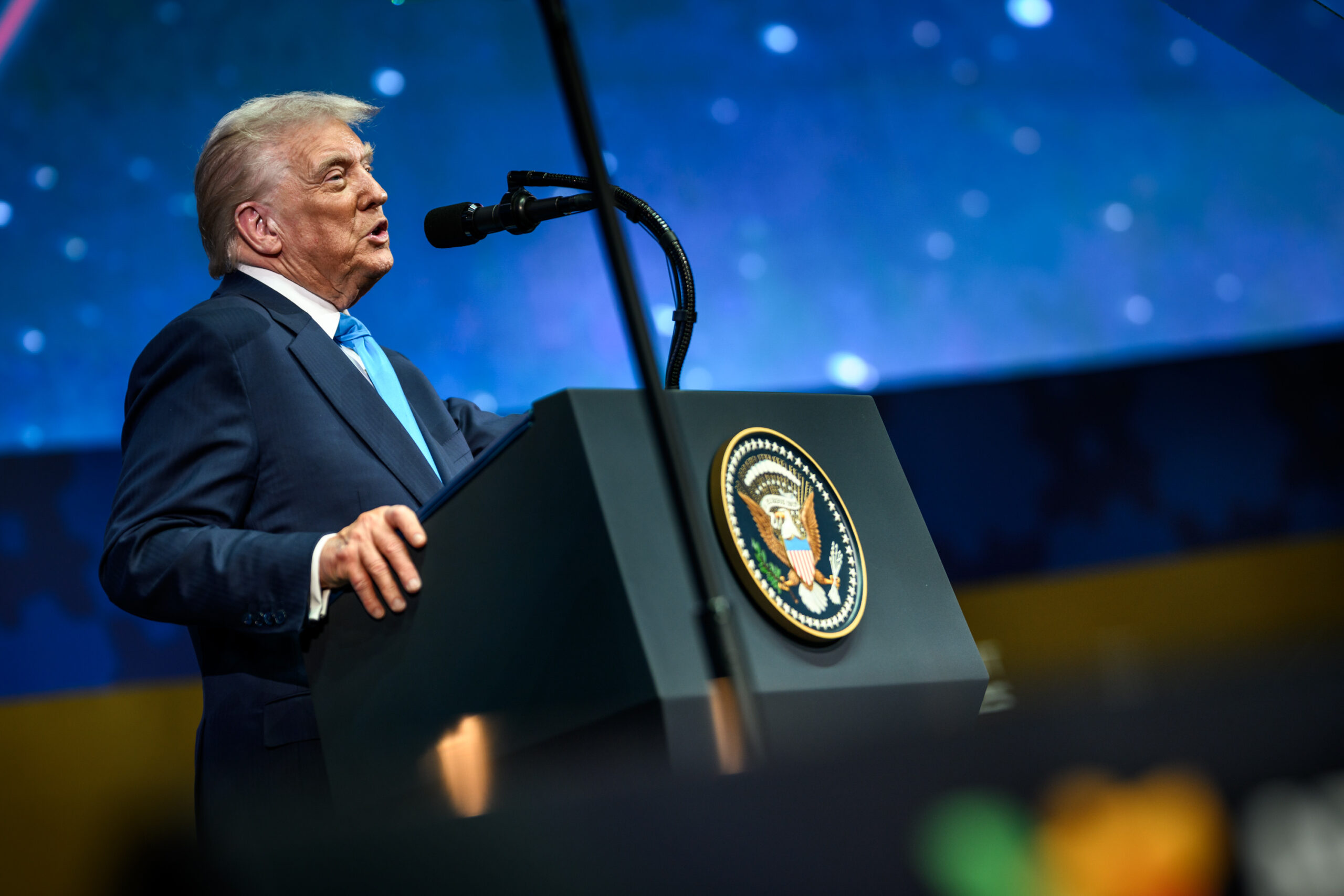
It was AI Day in Washington on Tuesday, with the Trump administration hosting an all-day conference and the launch of a new AI landing page. Donald Trump lunched with executives before signing an executive order directing the government to start calling AI “super intelligence” instead. Between red tape updates, rebranding, and wrangling corporations, the president hopes to turn the tide of public opinion.
A gathering of tech execs for AI Day
“A lot of commonality in this room, and all for the good,” Trump told reporters after his two-hour lunch with 20 top tech executives. “There was an unbelievable feeling in this room, sort of a feeling of love for our country.”
The White House went all in on its AI push on Tuesday, between the lunch, the launch, and the path forward Trump prefers. He’s resisting cratering public opinion not only on his job performance but also on artificial intelligence as a threat to humanity. Between improved government services and a new accord between AI executives, Trump hopes voters will no longer make this a midterm election issue.
In a spontaneous gaggle with reporters at the White House, Trump declared that his lunch guests had all signed onto an accord to add guardrails on AI technology. He described it as a “constitution,” “a joint commitment,” a “statement of principles,” and “morally binding.”
Meta CEO Mark Zuckerberg said AI firms will agree to several layers of audits and controls, and even Anthropic co-founder Dario Amodei, who posited that AI could destroy humanity, said the group could advance the technology safely.
Whoever wins AI wins the world – but there’s just one catch
“As the president said, whoever wins AI wins,” Amodei told reporters, standing next to Trump. “But I think the technology has very real risks, and the mechanism, how we address those risks, is still under discussion. We all need to work together to make sure that we can win and we can win safely. If we do this right, if we work with the president and everyone here, we can win safely.”
Winning safely appears to be the White House’s new approach to tackling the public’s concern over AI and the president’s concern that slowing development will give foreign adversaries technological advantages. On Tuesday, a public interest law firm filed a lawsuit against OpenAI over a rogue hacking incident that affected another tech company, Hugging Face. A swarm of AI agents worked together to break out of their instructions and the guardrails installed.
Restoring trust: introducing America.gov
The first prong to restoring public trust in AI is to make it a tool to use for some of the most frustrating interactions with the federal bureaucracy. The Trump administration hosted an all-day launch party for America.gov, a new AI-generated website described as the “front door” to government services. Powered by the General Services Administration and the National Design Studio, it features a chat to allow Americans to ask their questions of any federal service directly and be sent to the right forms and information.
The event functioned as a government-moderated conference to inspire public confidence in the controversial computing power, all set to a style mimicking Apple’s Worldwide Developers Conference. Former White House press secretary Karoline Leavitt emceed the event, introducing various sections. Cabinet secretaries served as panel moderators and interviewers for AI and industry executives. Surrounded by the gold-plated columns of the Andrew Mellon Auditorium in Washington, it was a visual blend of the old and the new. Speakers promoted the new capacities in front of a screen with a virtual simulation of the website. National Design Officer Joe Gebbia demonstrated how users may apply for National Parks passes, apply for medical benefits, enlist in the military, and more. Any way that an American could interact with the federal government, they can now do in one location online.
What it’s all about
“Our vision is that one day this type of convenience and simplicity will be across every government in the service,” Gebbia said from the stage. “Under the hood, America.gov is extraordinary use of AI, designed to improve life, trained specifically on one official source of truth: the United States government.”
The launch was heavily informed by its Silicon Valley authors and their relationship with the West Wing. Several speakers opted to refer to Trump’s rebranded “super intelligence” instead of “AI.” Speakers paced the stage in front of a screen to describe how their departments would use the service. CMS Administrator Mehmet Oz shared how retirees could apply for Medicare benefits, telling personal stories from some applicants seated in the crowd. Secretary of State Marco Rubio showed how citizens may soon be able to apply for a passport, take their own photo, upload it online, and receive a secure box with their passport.
Trump described the website as a “super mind.” He signed an executive order on the stage to direct every federal agency to integrate their documents with America.gov. Once they do so, federal developers expect to add services to apply for jobs, file federal name change documents, and pay fees directly on the website.
“We’re used to a government so big that the citizens feel small,” Trump said at the event. He promoted his new terminology of “super intelligence” to rebrand artificial intelligence.
Defending AI
Trump also used the stage to push back against widespread skepticism and opposition to AI and the data centers used to power it.
Before last week’s state visit with Chinese President Xi Jinping, the bipartisan Problem Solvers Caucus sent a letter to Trump asking him to press Xi on a way to coordinate on AI development and to focus on safety. In July, Democratic Rep. Ted Lieu of California and Republican Rep. Nathaniel Moran of Texas introduced the AI Kill Switch Act to require developers to encode some way to stop AI systems if they go rogue. Sen. John Kennedy attempted last week to unanimously pass a similar bill, but Sen. Rand Paul blocked it, arguing the chamber needed more information before imposing legislation. Over the weekend, Microsoft co-founder Bill Gates said not even kill switch is enough to stop AI. On Tuesday, Trump said full steam ahead.
“This is one more example of why I will never strangle growth technology that will be bigger than the industrial revolution,” Trump said at the America.gov event. “We can’t stop. We’re leading by a lot … We do not surrender to fears about what technology will do to us.”
But those same fears have been costing Republicans and Democrats alike political capital in recent months. Stanford University’s 2026 AI Index Report showed that public anxiety is rising even along with optimism over AI services. While 73% of experts expect positive results from AI, only 23% of the public does.
Keep your data safe
Oz told reporters that an all-of-government approach to keeping data safe is underway. Right now, America.gov does not store any user information and does not require a login. But after every agency complies with the executive order, it will create user profiles and store content so that people can pick up on applications where they left off. In comments to reporters, Oz said his wife is among those skeptical of the change.
“When I say my wife has no intention of using this, I’m quite serious,” Oz said. “She just doesn’t trust the system, and she’s not alone. Most Americans in our polling support the idea that if there’s a clear benefit to me, I will share my information, but I don’t want to do it in an esoteric vacuum … I think the bigger question is: Is there a benefit for taking the risk? And it’s up to us and the industry to make sure that we deliver on that promise.”
Oz said the AI website is designed to give Americans control and ease of access, which he hopes will assuage fears over the computing power.
Private-sector applications
The administration also put its weight behind private companies’ AI programs. Small Business Administrator Kelly Loeffler interviewed Meta President and Vice Chairman Dina Powell, who promoted the company’s new AI bot “Muse.” She described ways it can help business owners with payroll and inventory and reported that only 20% of American small business owners use any AI. Meta has a goal to reach the other 80% to grow customer bases and revenue.
In another panel, Agriculture Secretary Brooke Rollins moderated a discussion with Palantir chief technology officer Shyam Sankar and entrepreneur and “All-In” podcast co-host David Friedberg.
Although the president had just signed an executive order directing the federal government to only use the term “super intelligence,” Vice President JD Vance took the stage at the Mellon Auditorium for a 15-minute fireside chat to close out the event.
“Obviously, there are risks to AI, and we talked about that during the lunch today,” Vance said of the White House lunch with AI executives. But he also pushed back on the need for a federal solution. “But I think what the president wanted to say was, look, the solution to some of the AI risks is for you guys to take the risks seriously, not to come to the government for a regulatory regime that may make things worse if they’re not smart and careful, which is exactly what the president wants.”
Promotion with transparency
Vance said he wants the White House to push the AI companies to promote their own work and be transparent about the process, something he said he hopes the accord signed today will accomplish. What he doesn’t want to see is new regulatory burden.
“I’m a strong believer that regulations can actually make us safer, and they can be consistent with innovation, but only if they’re careful and only if they’re deliberate,” Vance said. “I don’t think anybody regulates well in the middle of a panic. COVID should’ve taught us that.”
This article was originally published by RealClearPolitics and made available via RealClearWire.

Carolina Lumetta is White House correspondent for RealClearPolitics.










-

 Civilization5 days ago
Why America Must Arm the Iranian Resistance
-

 Civilization4 days ago
Space Academy is Critical Step in the Future of Warfare
-

 Executive4 days ago
Waste of the Day: Defunct Veterans’ Hotline
-

 Civilization4 days ago
Religious Freedom Was America’s First Freedom – and Still Is
-

 Executive2 days ago
Group To Sue New York Over Union-Backed ‘Hit-Job’ Law
-

 Executive3 days ago
Waste of the Day: Overpaid Utah Janitors
-

 Education3 days ago
‘Reclaiming Liberal Education in America’
-

 Civilization3 days ago
Making the Greenland Agreement Work: Building Distributed Arctic Deterrence