
Executive
Waste of the Day: Congressional Staffers Unaware of Improper Payments Website
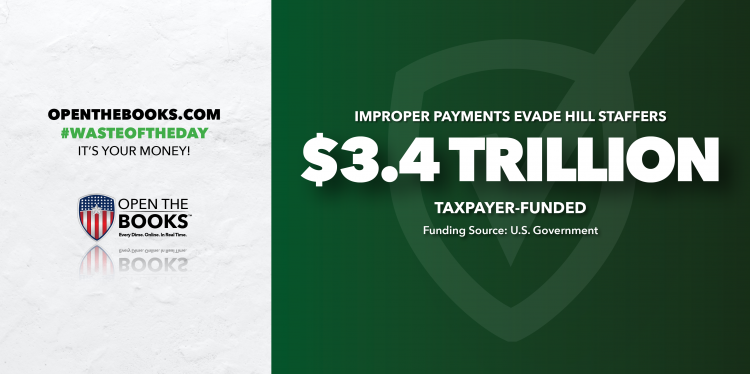
In November, OpenTheBooks audits improper payments reported on PaymentAccuracy.gov, revealing Congressional staff’s lack of awareness about the site. Since 2004, $3.4 trillion has been lost to improper payments. Although agencies are held accountable, many staffers face challenges accessing detailed information, hindering effective oversight by Congress.



Topline: Every November, OpenTheBooks’ auditors head to PaymentAccuracy.gov to review annual data about improper payments: money the government sends to the wrong person or for the wrong amount.
Why don’t more congressional staffs consult this improper payments website?
Apparently, not everyone in Washington D.C. is doing the same. Multiple Congressional staffers are “completely or somewhat unfamiliar with the existence of the website,” according to a Jan. 23 report from the Government Accountability Office.
Congress controls the purse strings, but how can legislators do so effectively without tracking where the money goes?
Key facts: The federal government has lost $3.4 trillion to improper payments since 2004, adjusted for inflation. OpenTheBooks was able to calculate the number because the Payment Integrity Information Act requires most federal agencies to post their mistaken spending online.
Not every Congressional employee knows where to find the data, the GAO reported. Some staffers said they use agency financial reports and other sources to track improper payments, but the GAO pointed out those sources usually only contain a “brief statement indicating that more detailed information could be found on the website.”
Other Congressional staffers said they tried to use PaymentAccuracy.gov for their oversight work, but pop-up windows and glitches obscured some numbers.
Many agencies let improper payments go
Background: Inspectors general review almost every federal agency’s submissions to PaymentAccuracy.gov to make sure they are accurate and complete. Ten agencies were recently found to be noncompliant in 2022, the GAO reported. They must now develop written plans for tracking their improper payments and appoint a new official who is responsible for accuracy.
Nine of those agencies were also noncompliant in 2021. They must now include their written plans in the president’s next budget request to Congress, expected this February.
Search all federal, state and local government salaries and vendor spending with the AI search bot, Benjamin, at OpenTheBooks.com.
Critical quote: “The absence of explicit information in agency financial reports specifying that plans to come into compliance are available on PaymentAccuracy.gov, lack of congressional awareness about the information included there … could compromise Congress’s ability to obtain key payment integrity information needed to conduct effective oversight of improper payments,” GAO auditors concluded.
Summary: The executive branch’s transparency with improper payments is impressive, but it’s all for naught unless Congress uses it to make actionable changes.
The #WasteOfTheDay is brought to you by the forensic auditors at OpenTheBooks.com
This article was originally published by RCI and made available via RealClearWire.
Terry A. Hurlbut has been a student of politics, philosophy, and science for more than 35 years. He is a graduate of Yale College and has served as a physician-level laboratory administrator in a 250-bed community hospital. He also is a serious student of the Bible, is conversant in its two primary original languages, and has followed the creation-science movement closely since 1993.

Jeremy Portnoy, former reporting intern at Open the Books, is now a full-fledged investigative journalist at that organization. With the death of founder Adam Andrzejewki, he has taken over the Waste of the Day column.






-

 Education4 days ago
Everything’s Bigger in Texas, Including School Debt
-

 Education4 days ago
Restoring Duty to God and Country
-
 First Amendment3 days ago
Oregon’s Union Crackdown Spreads
-

 Guest Columns3 days ago
Living in the Empty Tomb Era
-

 Executive2 days ago
The Straits of Hormuz Should Not Be a U.S. Problem
-

 Executive3 days ago
Waste of the Day: Maryland Ignored Audit Warning, Increased Overtime
-

 Civilization2 days ago
How China Dominates the World’s Critical Minerals Production
-

 Executive2 days ago
Waste of the Day: Fiscal Doomsday Reached With $193.6T Gap