
Civilization
Vance Defends Operation Epic Fury After Years of Opposing Interventions
Vice-President J. D. Vance firmly supports the blitzkrieg against Iran, though he opposed most foreign interventions for years.


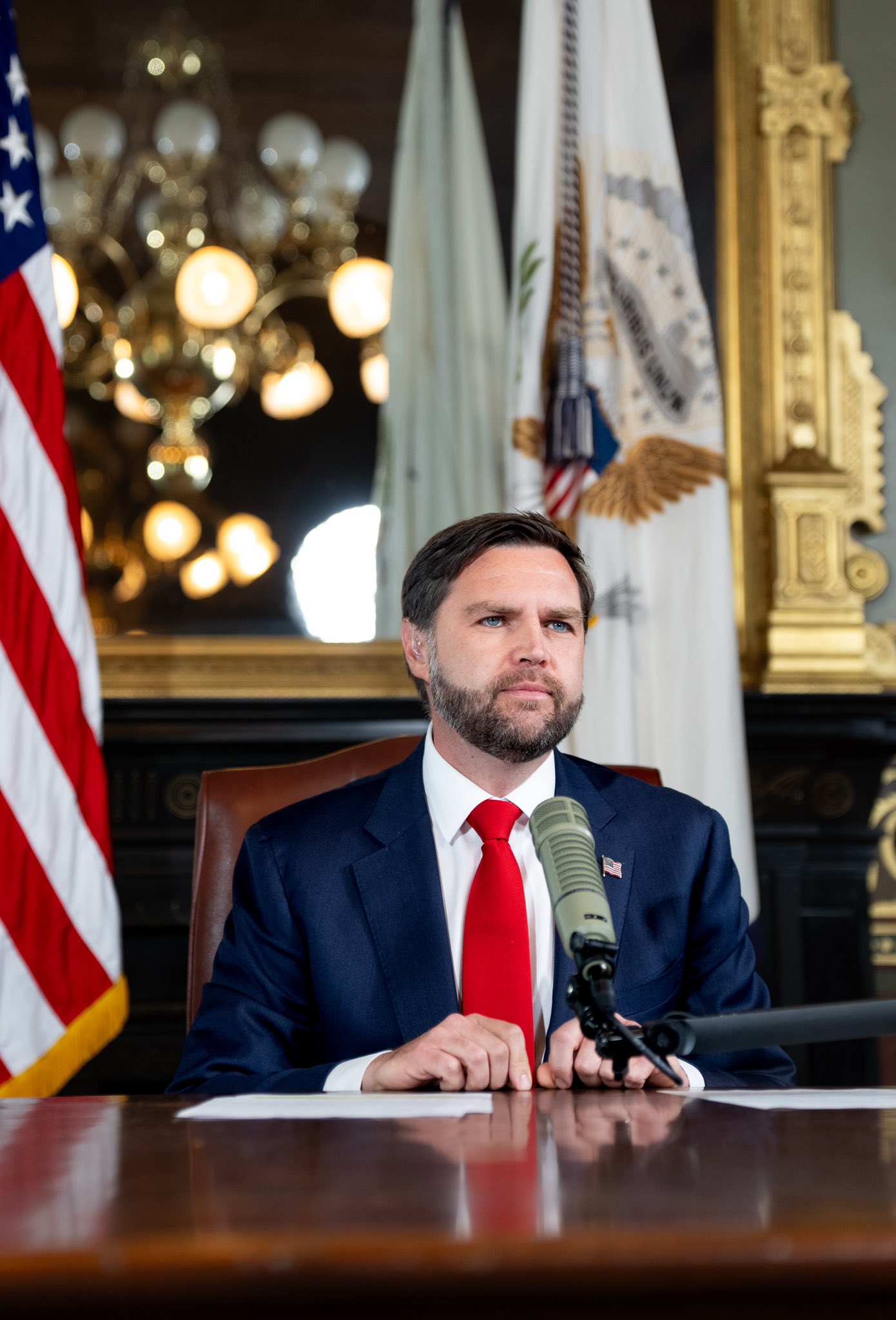
On the third day of the new war with Iran, and after years of building a political reputation grounded in opposition to foreign intervention, Vice President JD Vance broke his silence: He supports the strikes and believes the latest adventure abroad is not only prudent but consistent with his and President Trump’s promises not to risk American lives for regime change.
What made Vance change his mind – or does this war meet different criteria?
The difference between this conflict and the Global War on Terror, Vance told Jesse Waters of Fox News, was that Trump “is not going to let his country go to war unless there is a clearly defined objective.” The stated aim in this case is to ensure Iran can never develop a nuclear weapon.
“It is pretty clear,” said the former Marine who deployed to Iraq. “It is pretty simple,” concluded the most prominent anti-interventionist in this administration.
But it is also a political liability for the MAGA heir apparent. The vice president rose to that role, in large part, as the vanguard of a strict kind of America First thinking. He endorsed Trump for a second term in a Wall Street Journal op-ed “because I know he won’t recklessly send Americans to fight overseas.” The headline for that 2023 guest essay read: “Trump’s Best Foreign Policy? Not Starting Any Wars.”
The apparent evolution left anti-interventionist allies disappointed. Sohrab Amari, a post-liberal conservative and close friend of the vice president, concluded that Vance “lost the foreign policy war,” bemoaning how a critic of neoconservatism rose to the highest levels of government “only to help implement the foreign-policy preferences of, say, John Bolton or Elliott Abrams.” Conflicting stories further complicated the controversy in New Right circles, with the New York Times simultaneously reporting that Vance had leaned against striking Iran but also pressed for a “go big and go fast” approach.
Vance needed no convincing – Trump
A spokesman for the vice president declined to comment. But President Trump dismissed the idea that Vance required any convincing, telling RealClearPolitics during a brief Monday interview that his No 2 “did not take persuading.” All the same, war drums were not broadcast during the campaign.
While Trump and Vance stumped on a platform of “no new wars,” once in office, they have launched strikes against the Houthis in Yemen, decapitated the Venezuelan regime with a daring raid to kidnap dictator Nicolas Maduro, and now threaten to topple the regime in Iran. At first glance, this makes an unusual resume for Vance, a candidate who once accused neoconservatives within his own party of being too bellicose and eager to play “a chess game with the lives of other people’s children.”
All of it was too much for former Rep. Marjorie Taylor Greene. A loyalist-turned-spurned critic, the Alabama Republican lit into the White House for the war in Iran during a Monday interview with Megyn Kelly and took special aim at the vice president. She demanded, “Where the hell is JD Vance?”
Hours later, Vance appeared on Fox News, where he defended what he described as a limited strike with specific goals. This has become an increasingly common sentiment within an administration bothered by comparisons to former President George W. Bush. They have defined objectives, Trump officials argue, unlike the open-ended commitments of the GOP old guard.
Did he really oppose any and all foreign interventions?
Vance allies rushed, meanwhile, to argue that the VP wasn’t entirely opposed to every intervention. They point to his speech at the 2024 Republican National Convention when he advocated for a judicious response to enemies abroad, declaring that Trump would “send our kids to war only when he must” and vowing that “when we punch, we are going to punch hard.”
Kevin Roberts, the president of the Heritage Foundation and close friend of Vance, said he doesn’t see any inconsistency so long as the White House stays within three “bright red lines.” He said that if the administration avoids a drawn-out conflict, rules out nation-building entirely, and continues constant communication, neither Trump nor Vance will run afoul of their campaign promises.
“This is not a time for neocons to be spiking the football,” Roberts cautioned. “They have not won this debate. The people who won this debate, most importantly, are the American public who say, we do not want forever wars.”
On this question, however, the early polling picture is not encouraging for the administration. Nearly 60% of the public disapprove of the U.S. decision to take military action in Iran, according to a recent CNN poll, as most say a long-term military conflict between the two nations is likely. Only a quarter of Americans, but a majority of Republicans, approve of the strikes, per a similar Reuters/Ipsos poll.
Ignore the early polls
Longtime Trump pollster John McLaughlin dismisses those early results as inconclusive. He noted that Trump did not take a hit after the first strikes on Iranian nuclear sites last summer and predicted that the president would not suffer because of his ongoing campaign against Tehran. “A lot of people thought they knew the Trump base,” McLaughlin said, “but they don’t.”
It is a maddening dynamic for those who would seek to read into Trump their own policy preferences. He has strong opinions, sources close to the president often say, but they are loosely held. He changes his mind frequently, often with little regard to past policy positions. None of it is inconsistent, the president has argued, because the populist movement he now leads is his own creation. “Don’t forget, MAGA was my idea. MAGA was nobody else’s idea,” Trump told Laura Ingraham of Fox News last November when his base was beginning to revolt over his flip-flop on allowing Chinese nationals to study at U.S. universities. “I know what MAGA wants better than anybody else.”
McLaughlin cautioned that a failure to understand that shifting political terrain has doomed some MAGA-adjacent Republicans. “Marjorie Taylor Greene isn’t running for a reason, and Thomas Massie is losing for a reason,” he said of the former Alabama representative and current Kentucky Republican who have lashed out at Trump over foreign policy in recent days.
The base is with President Trump. He has been loyal to them, and they’ve been loyal to him. It hasn’t changed at all.
Still a party of hawks
It is unclear whether that loyalty will translate come 2028, or if Vance can prove as philosophically flexible. Already some critics have been quick to pronounce the Vance presidential ambitions dead. “The differentiator is gone,” opined former NBC newsman Chuck Todd after the strikes on Iran, noting that skepticism of foreign wars was a hallmark for Vance, but now “his America First credentials are just non-existent. There is no recovering from this.”
One thing that remains indisputable: Neoconservative hawks are delighted. John Bolton, Trump’s former national security adviser, praised the strikes on Iran but admitted in an interview with the Wall Street Journal that he was “as surprised as anybody.” Another neocon, former Secretary of State Mike Pompeo, couldn’t be more different than Vance on foreign policy. But during the campaign, Pompeo stressed the difference between running for office and governing, telling RCP at the time that with a little real-world experience, leaders like Vance will eventually “get to a good place.”
A good place may be relative, judging from the reaction of another close friend of the vice president. Tucker Carlson, the former Fox News host, told Jonathan Karl of ABC News that the war in Iran was “absolutely disgusting and evil.”
Despite the protests from some loyal to Trump, a source close to the White House downplayed the idea of a larger divide among the Republican Party.
What sitting members of Congress are getting pulled away here: Thomas Massie, Warren Davidson, and Sen. Rand Paul? Okay, that’s three. It’s such an exaggeration.
At the end of the day, the average Republican voter does not spend all day scrolling on X and living in that thought bubble. They like dropping bombs on terrorists and killing people that proclaim death to America. We like delivering justice to those who have killed Americans.
Republicans are still a party of hawks.
Ostensibly this includes Vance, once the most prominent anti-interventionist.
This article was originally published by RealClearPolitics and made available via RealClearWire.

Philip Wegmann is White House Correspondent for Real Clear Politics. He previously wrote for The Washington Examiner and has done investigative reporting on congressional corruption and institutional malfeasance.



-
 Civilization4 days ago
Election Reform Republicans Can Actually Pass
-

 Civilization4 days ago
Redefining Strategy in the High North: Wargaming a Contested Arctic
-

 Civilization3 days ago
The GOP’s Latino Reset Can Happen Now
-

 Executive4 days ago
Waste of the Day: Feds Bought Golf Carts For $8.4 Million
-

 Executive3 days ago
Waste of the Day: NYC’s $3.5 Million Toilets Are “In Purgatory”
-

 Civilization3 days ago
The Kremlin Is Killing the Tool That Sold Its War
-

 Civilization2 days ago
Does the Donroe Doctrine Now Extend to Outer Space?
-

 Civilization1 day ago
How Prepared Is the Defense Industrial Base for Iranian Cyber Attacks?