Guest Columns
Waste of the Day: Radioactive Wasted Money
The US government tends to treat radioactive waste as high-level if any doubt exists, but new laws could see reclassification as low-level.


Topline: The federal government is so prone to excessive spending that it is even wasting money on waste itself.
How to handle radioactive waste
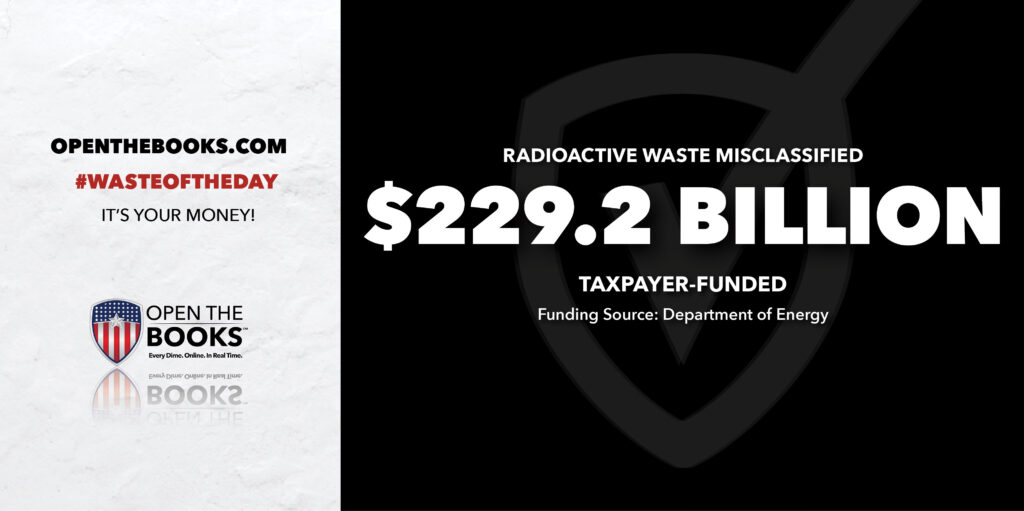
The Department of Energy could save up to $229.2 billion over the next several years by changing the way it disposes of nuclear waste, according to the Government Accountability Office. A vague and poorly understood law from the 1980s makes the process overly burdensome and expensive.
Key facts: The Department of Energy is in charge of treating water, soil, equipment and more that were contaminated from nuclear weapons production during World War II and the Cold War.
Disposing of “high-level” radioactive waste is time-consuming and expensive. It must be stored for years to let some of its radioactivity decay, and then it is buried deep underground. “Low-level” waste, which has less radiation, is easier to get rid of. It gets placed in a steel or concrete drum and is buried just a few feet below ground.
But, according to the GAO, the definitions for each kind of waste are ambiguous and have not been updated since 1983. There is no standard way to measure what federal law considers “highly radioactive.”
A better classification system
To be safe, the Department of Energy errs on the side of classifying nuclear waste as high-level. It spends billions every year on the expensive storage and burial of waste that would likely be classified as low-level if the 1983 law were updated. The department told the GAO that otherwise, it might be sued by environmental advocacy groups for not following a strict interpretation of the law.
Nuclear waste treatment plants are located in New York, South Carolina, Idaho and Washington. The Washington site alone could save up to $210 billion in 14 years by classifying 80% of its high-level waste as low-level without sacrificing safety, according to the GAO. The other three sites could save a combined $19.2 billion.
Search all federal, state and local salaries and vendor spending with the world’s largest government spending database at OpenTheBooks.com.
Summary: Congress should consider updating the legal definition of high-level radioactive waste if cost savings can be realized without compromising safety.
The photo of one-dollar bills is by Alexander Grey on Unsplash.
The #WasteOfTheDay is brought to you by the forensic auditors at OpenTheBooks.com
This article was originally published by RealClearInvestigations and made available via RealClearWire.

Jeremy Portnoy, former reporting intern at Open the Books, is now a full-fledged investigative journalist at that organization. With the death of founder Adam Andrzejewki, he has taken over the Waste of the Day column.